How Podcast Spaces Support Research, Teaching, and Community
Kerr Hunter: So the gateway to
the university can be this space.
And if we can make it as welcoming as
we can, then that's a testament to the
university's approach to the civic agenda.
And we want to be making sure people
feel that this university is for them.
We've got this prestige that people can't
come here and just be themselves, and
they very much can, and hopefully we can
be that foothold for people to get in.
Abigail Harrison Moore: And is that
almost you have to welcome people in?
I know I was scared.
I still am scared sometimes of
going into spaces I don't know.
And what you did, and what Helix did,
was you opened the door And one of
the outcomes is a number of the young
people are seriously considered or have
managed to get onto university courses.
They would have never have thought
about university, and one of the things
we're thinking about is how did working
within Helix, doing a podcast that
they wanted to do, this was their idea,
how did we make this weird space of a
university hospitable and welcoming?
And once we opened that
door, how we did that.
Neil McPhedran: Welcome to Continuing
Studies, a podcast for higher
education podcasters who want to
learn, connect, and get inspired.
I'm Neil McPhedran, founder
of HigherEdPods.com and
Podium Podcast Company.
Jennifer Lee: And I'm Jennifer-Lee,
founder of JPod Creations.
If you're podcasting in
higher ed, you're not alone.
There's a fast-growing
community out there, and we're
here to help you tap into it.
Email us your ideas if you
wanna be on our podcast or know
someone we should interview.
Our email is in the show notes.
Neil McPhedran: Yes, we'd
love to hear from you.
Okay, Jenn, this one is quite different
because you're not on this one , so it-
Jennifer Lee: Still salty about it.
Neil McPhedran: Yeah.
Well, I'm not gonna say it's not
as good because the three people
we have on are pretty amazing,
but we definitely missed you, so
Jennifer Lee: that's for sure.
You're not as good without me as a host.
Neil McPhedran: I, I felt, I, I, I felt
like there was times when I was waiting
for you to chime in on a question
so I could get time to think about
what my next question was, so that's
what I do enjoy about working tandem.
It gives you time to kinda
like ping pong stuff back and
forth, but I think I did okay.
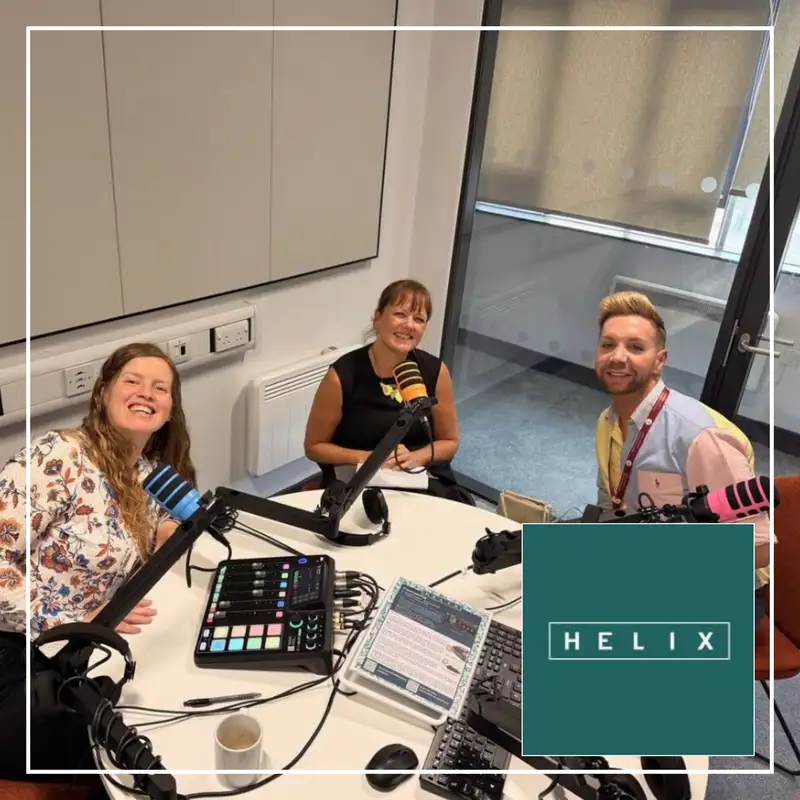
So Jenn, in this episode, I
recorded at the University of Leeds
when I was over there for EPOD.
We recorded in this really awesome
space at the University of Leeds called
Helix, and in there is a podcast studio.
This is actually the third episode
in our little miniseries here where
if you go back, we interviewed
Abigail Harrison Moore, a professor
at the University of Leeds, and
she talked about her participatory
research project, Whose Power?
The studio we recorded in is
actually where she produced those
episodes for the Whose Power?
show The second person who's part
of this interview is Krissie Glover.
She's the founder and director of Research
Podcasts, which is a UK-based podcast
production company, and they specialize
in academic and research podcasting.
Krissie and her team actually
worked with Abigail to produce
the Whose Power podcast series.
The third person is Kerr Hunter, and
he's the senior manager of Helix at the
University of Leeds, and him and his team
were quite involved with the podcast and
the, the research project as well, too.
So this is the third in our series
pulling this all together in the
actual space with all the folks.
So make sure you go back and
listen to those other two episodes.
We'll make sure there are links
in the show notes to them.
I need to make one correction from going
back to the episode with Professor Moore.
I mispronounced the name of
the youth organization, which
is all part of the research.
It's the Preservative Party.
I called it the Preservation Party, so
I just want to make that correction,
that it's the Preservative Party is
the name of the, the group that is
part of that participatory research.
This is a great episode.
And Jenn, we missed you.
Jennifer Lee: Well, I'm happy that you
were able to be in this amazing space.
So I'm sure you guys had a great time.
I'm still a little
jealous, but that's okay.
I know you probably did an
awesome job, so let's hear it.
Neil McPhedran: Yep.
Let's get into it.
So we're recording today from
Helix at the University of Leeds
with Krissie, Kerr, and Abigail.
I'm here for my first EPOD conference,
and we're sitting in the space that
actually played an important role
in the creation of Whose Power.
For the listeners, what is Helix?
And Kerr, let's throw it to you.
I think this would be a great … If
you could explain what this fabulous
space is that we're sitting in.
Kerr Hunter: Yeah.
So Helix opened in September 2023.
It was intended to be, and is, a
collaborative- Innovation space.
It's geared towards student education,
but alongside that, it's for staff
and the wider community, and that was
how I first got in touch with Abigail,
was through that community activity.
We're super well-used by students.
It's often used as a meeting place.
People come down to do some studying.
But the main intention of it is
to have courses specific activity
within different design spaces.
So we've got immersive
technology focus space.
We've got a maker space.
We've got collaborative working spaces.
We've got studio space, podcasting,
where we are right now, and studio
space for photography and filming.
Neil McPhedran: It's
quite a fabulous space.
I'm blown away by the studios.
There was VR stuff outside there.
You guys are quite fortunate
to have this space.
Have you found that if you
build it, they will come?
You've put this whole thing together, and
then these things have come out of it?
Or was there a plan
originally in place for it?
Kerr Hunter: Yeah, there was
a plan I think there's two
answers to your question.
I think with early adopters, if you put
something out there, they will come.
But that's only a specific
section of people.
We were guided from the start that
we had to be a programmed space
because people don't just come.
Like, you have to be demonstrating, "If
you come here, this is what we will do,
and this is what we can offer you, and
this is what you can get involved with."
Otherwise, I feel like people do come
in, and when you walk in, it has got
quite a relatively corporate feel, I
think, that can put people off initially.
And I think that programmed activity
needed to happen so people didn't
feel they're walking into a group
of offices and they're gonna
see staff working at their PCs.
Once you get into the weeds of it,
you find a lot of fun stuff, and you
see, especially the maker space, it's
messy, and there's paint everywhere,
and that kind of side of it isn't
the kind of the corporate feel.
Neil McPhedran: Have you found
that because of Helix, podcasting
has changed, more opportunities
have cropped up at Leeds?
Kerr Hunter: Yeah, definitely.
So the University of Leeds has
adopted podcasting for assessment
in terms of module activity.
So module leaders can choose to
do podcasting as an assessment
opportunity for students to take.
Abigail Harrison Moore: Mm-hmm.
Kerr Hunter: Not everyone does, but
those who do, we then work with those
module leaders to make sure they're
aware of what we have down here.
Mm-hmm.
But when you've got equipment
like we've got here, and it's for
free, anyone can use it for free,
why not take that opportunity?
So I guess it's raising awareness
from that point of view.
But also it's great for, we call it
experiential learning- Mm. -which ties
into surfacing skills, raising the skill
sets of students to be more work ready.
I'm not saying every job has
podcasting, but if you're going into
the creative industries, having that
experience when you leave university
is a great thing for your CV, that
you're not having to learn on the job.
Yeah.
You can actually say, "I've done
this podcast," or, "I did this as
my assessment," or, "My group of
colleagues and I have run a podcast
for the last year, and you can
hear it here on Spotify." Mm-hmm.
So that kind of stuff is a selling point
when they're going into the job market.
Neil McPhedran: Yeah, just even
getting in front of a mic, being
in this, it can be intimidating.
Yeah.
So I think that's a great opportunity for
students to have had that, and to your
point, to put that on your, on your CV.
So let's switch from studio
space to research space, and
we're sitting in this very space
where Whose Power came together.
Looking back, what role did Helix
actually play in that project?
Abigail Harrison Moore: I think listening
to what you were saying, Kerr, it makes
absolute sense, even though at the time
when we first start- 'cause I started
the project in 2023 January So we were
very early on in terms of thinking about
what was the potential of this space.
And I think you and everybody here were
really open, with everybody I work with
and with Chrissie and Chris and Research
Podcasts, for me coming in saying, "I
don't know what we're going to do."
I g- already had started to learn
very carefully with the group of young
people, the Preservative Party, what
they would need in advance in order
for us to do something that was really
exciting and that spoke to their… Help
them feel safe and trust the process.
And you were really open because
as you say, it does feel quite
corporate when you come in.
But when I came and talked to
you, we talked about ethics.
Mm. Going through the ethics process with
Chrissie and with Kerr, with everybody
who's worked with our photographer,
Andy, has been a really important
part of the process because when you
go through the information sheet, it
allowed us to talk about the structures
we're putting in place for iterative
ethics, what might be the concerns,
what the group wanted, what they needed.
So it was really important for me
to learn that and then to translate
that, and you were really open to it.
And so when we did our first training
session in here, we did it a weekend,
which wasn't the norm at the time, so that
we could create a space that was just for
us And then once we'd brought in the food
that we like, they got used to the sofas,
the classroom spaces, the coffee machine.
Suddenly became, thanks to you, a
home for a group of young people
who had never been to campus before.
Neil McPhedran: Hmm.
Abigail Harrison Moore: And
that was really important.
So I think one of the things that we've
learnt together is how this space that
was very much constructed for the students
at the University of Leeds and for
academics at the University of Leeds,
has become a really important part of
our offer to the communities in our city.
And Leeds is a very small city for
those people who don't know Leeds.
It's a very cultural city, and it's
very, very high up on our strategy.
It's been very important to me
forever because I set up memorandums
of understanding with the
museums in Leeds a long time ago.
But it's really our campus, we
hope isn't intimidating, but it is.
It's a huge campus.
We have something like
35,000 students here.
You know, after 32 years,
I still get lost on it.
But actually, it's a very safe
space once you're introduced to it.
And so what Helix became for the
Preservative Party, and what you
enabled us to do, and what this
studio space, which feels like home.
When I come back into this studio space,
it's like, "Oh my gosh, all of that
happened here." You made it hospitable.
Yeah.
Kerr Hunter: Yeah.
I think as well, just touching on that
point around the sort of welcoming space.
I've talked to various different senior
leaders at the university about this, but
actually I feel like that's where Helix
can actually come into its own in terms
of the civic agenda of the university,
because we actually are an open…
In the literal sense, like once
you're past the main door, there
is no barrier to anyone being here.
Unlike, no disrespect, these
things happen all over the place,
but libraries have turnstiles.
You need to have a matriculation.
You need, you need to be a
student or a staff member to gain
entry unless it's prearranged.
In here, you really don't.
So the, the, the gateway to the
university can be this space.
And if we can make it as welcoming as
we can, then that's a testament to the
university's approach to the civic agenda.
And we want to be making sure people
feel that this university is for them.
We've got this prestige that people can't
come here and just be themselves, and
they very much can, and hopefully we can
be that foothold for people to get in.
Abigail Harrison Moore: And is that
almost you have to welcome people in?
I know I was scared.
I still am scared sometimes of
going into spaces I don't know.
And what you did, and what Helix did,
was you opened the door And one of
the outcomes is a number of the young
people are seriously considered or have
managed to get onto university courses.
They would have never have thought
about university, and one of the things
we're thinking about is how did working
within Helix, doing a podcast that
they wanted to do, this was their idea,
how did we make this weird space of a
university hospitable and welcoming?
And once we opened that
door, how we did that.
Krissie: I think a couple of things
you brought out there, though, that
they chose it, and I think that's
really important for co-creation.
So we go into these models saying
to them, like, I talk to a lot
of researchers, and we have these
ideas when we go into the room that
we want it to work a certain way.
But actually, what I learned from this
process is that you need to go in with a
scaffold, you need to go in with a plan,
and be ready for that plan to fall apart.
And be okay with it falling apart.
It is being okay with picking
up the pieces that are really
important and making mistakes and
being open to being challenged.
The Preservative Party worked with
me and challenged me, and they were
open for me to get things wrong.
And I think that's really important.
I think a lot of times we're
scared to get things wrong.
Like, we come and do the ethics, and
the ethics are like, "You need to do
X, Y, Z." But there is flexibility
to get it wrong, be corrected,
and be open to being corrected.
I think a lot of people, especially as
you come as the expert in the space, you
come in with an idea of what it should be.
But actually, what it should be
is what they want it to be, and
I think that's really important.
Abigail Harrison Moore: That
was really symbolized by that
wonderful photo we've used a lot.
We have a, a photographer who's worked
with us, Andy, through this whole
process and really got to know the group.
And within about a couple of minutes on
the first day when we were recording it,
one of the group had put a piece of A4
paper up on these corporate-type offices
with Production Office that they'd written
in felt tip, and they own the space.
And that's, that's the brilliance
of The Preservative Party.
While for multiple reasons this hasn't
been a safe space or education hasn't
been a safe space because of Helix
and the group and how they're enabled
by the Leeds Museums team there.
They owned it.
But they put the picture up- Mm … and
it was their production office,
and Whose Power Podcast was their
production and remains their production.
Krissie: And if you think about the
transition from Series 1 to Series
2- Mm … so we often talk about
kind of power imbalance, h-how
you address power, who has power,
literally that's where it comes from.
And in Series 1 they asked you
to be presenter because they
were comfortable with that.
And then once they were comfortable
in the room, they were like, "Mm,
actually, I think we want to present."
So we had to shift focus and give them the
training to be able to do that and give
them the space to achieve that as well.
And I think they did an amazing job.
And series two, you ended up bookending-
Abigail Harrison Moore: Yeah
…
Krissie: to br- So part of the funding
is about creating new knowledge.
So we talk a lot about when I
do co-creation, I talk about
we are used to deadlines.
We're used to funders asking for things,
whereas when we're doing research
with participants, they live lives.
They've got other things to do.
So what I found really interesting
through the process of letting them
present and doing it all in one day
is that you just kind of open the
door to new experiences for them.
And I think with you bookending, you could
bring in the new knowledge without taking
away from the fact that they owned it.
Abigail Harrison Moore: Yeah.
Neil McPhedran: One thing that struck
me when all three of you mentioned
it is there's an institutional issue
right now for higher education and
for universities, an erosion of trust.
I found it interesting as you guys were
talking of how Podcasting in the studio is
a way to build trust and a new way in to
get past that ivory tower up on the hill.
I think we're at an interesting moment
right now with the institution of higher
education and trust, but also access
to it and different ways of access.
It was interesting the way,
Curtis, specifically, you talked
about the openness and the way
into the institution as well.
Kerr Hunter: Yeah.
And I think with podcasting, as
everyone is aware, people are much
more comfortable now being able to
say that I'm neuroatypical, and how
do we as an institution support that?
Well, if you're neuroatypical
and you don't respond well to
writing an essay, why should you be
hindered if that's your only option?
So having the availability of something
like podcasting for assessment, and
people might feel comfortable presenting
themselves via voice, not by picture or by
video or not by writing, but just telling
their story, saying what they need to say.
That's a great thing that we should be
facilitating that option for students.
Mm-hmm.
But obviously, podcasting is one of
many styles of assessment that people
can choose via their module leader,
if that's the route they go down.
But it's becoming more important,
and it's becoming more open for
people to make those choices.
And yeah, I think that higher education
as a whole has to respond to various-
Mm-hmm … obviously, funding is a massive
challenge for higher education right now.
We're really lucky that we have
something like HELIC, so people of
all types of learning can have access
to all this equipment and skills.
'Cause I run a team of several people
who are very skilled in different areas,
and they can impart their knowledge
onto students, and it's not in a
teaching role, that's in a supported
technical role, making sure the students
have access to that technical skill.
Neil McPhedran: Mm-hmm.
Abigail Harrison Moore: I think
that's one of the interesting things
about this project that really helped
us think about the three pillars,
university life in the UK at the moment.
So obviously, for a long time you've
had the research pillar and the student
education pillar, and then more and
more, given it's the natural space
I place myself in, over the last 30
years, we've seen more and more the
notion of the community, the civic-
Neil McPhedran: Mm-hmm
Abigail Harrison Moore: widening out,
going out into the world, widening
participation, and both in terms of
student education and student outreach.
So a lot of the work that I do is
about enabling young people and their
teachers to think that they possibly
could come to a university like Leeds
or could possibly do the arts and
humanities or a creative subject.
But also in terms of research, thinking
very differently about who does research,
who owns research, how knowledge is owned.
And so for me personally, and we talked
about in the last episode that I did
with you, this wonderful growth in
understanding that research is not done
on, but research should be done with.
The podcast studio, as we talked
about last time, has become a really
important space, not only for enabling
to take place, for enabling researchers
whatever background they come from,
whether they've got a degree or
not, to come into this space and f-
feel strong and feel confident about
talking about what they've learned.
But in the research world, we
were so used to writing a book or
a journal paper, having it peer
reviewed and putting it out there.
I'm finding, and it's an argument in
the nicest way possible that I'm having
with colleagues within this university
and elsewhere at the moment about what
is the podcast as a research output?
Krissie: Mm-hmm.
Abigail Harrison Moore: And why is it
different to a book, and why should
we be using it to really speak to our
learning and our learning together?
And that is, I think, a journey that
we're only just starting to go on, and
I'm already hitting walls and barriers
in that where people don't listen.
Neil McPhedran: Yeah, I've, I've, through
Continuing Studies, this podcast, I've
been fortunate to chat with different
people from all over the world,
actually, that are in academia that are
working on this just as you laid out.
Krissie: Yeah.
And so we are talking tomorrow about the
power of podcasting as a form of research,
and we're gonna bring their voices to the
front, and that's really important for us.
So at the beginning, we're gonna play
a trailer from Series 2, where you
can see a video of us in the room.
And I know for podcast geeks
listening, video and podcasting
is a interesting conversation.
So this isn't a video podcast.
It's a video trailer.
I think without video, and I've
had this conversation with a
lot of people actually, um, you
leave your biases at the door.
Mm-hmm.
And I think that's important, and
it's important to us just to listen.
Abigail Harrison Moore: Mm-hmm.
Krissie: And I think you do then
equalize that power imbalance a lot more.
There is still a power imbalance.
Of course there is.
It's hard to get rid of it, but
we're challenging it, and we're
trying to challenge it that way.
So I think that's what we're
gonna talk about tomorrow from
the research podcast perspective.
I wanna talk to the podcast producers
in the room about take the risk.
Do it.
Give it… So for us, it
was a new thing to do.
We've done a couple more since in the
co-creation citizen action research space,
and it's the best thing I've done so far.
I love the students, and when Abigail
said to me yesterday, "Do you wanna
come to preservative party tonight?"
And I was like, "Yeah, I actually do.
I can't think of anything better.
Let's go talk to them.
Let's go have some Pringles and see what
they're up to, see what the next project
is." So that's why I'm really interested.
Abigail Harrison Moore:
They've got loads of ideas.
Yeah.
And of course, they drive it.
I think coming back to that notion of
hierarchy, though, is also interesting
in this space that we're in today.
Mm. Because, and obviously the
joy of podcasting is also it can
be immediately international.
Neil McPhedran: Mm-hmm.
Abigail Harrison Moore: And I think
that's really exciting for us 'cause we
talk a lot about- Yeah … how do you get
research into the international world?
How do you have those
conversations across the world?
And the podcast does
done well-
Neil McPhedran: Yeah
…
Abigail Harrison Moore:
can do that really quickly.
But in this space, there is also
someone needs to control the audio.
Mm-hmm.
Because actually the audio
of Whose Power is beautiful.
Mm. How you produced it, you know, you
and Chris with all your experience,
you could really hear the voices.
And, and because we actually invested
a lot of money in this space- In a way
that other organizations can't, but
a university could and took the risk.
Mm-hmm.
We've got really, really beautiful
audio equipment, and therefore
we're able to create a sound
quality that you just can't beat.
With all- Mm … the joy in the world,
you can't recreate- Mm … doing a
podcast on your laptop with a nice mic.
And also the fact that
we can come together-
Krissie: Mm-hmm
…
Abigail Harrison Moore: and
it becomes a conversation, and
that changes what you do- Yeah
in this space.
Krissie: And you take the
pressure off them as well.
So like we, if I'm honest, the majority
of our podcasts are recorded online.
And as you know, Neil, like you
put some onus on your guests.
Like, you expect them to have some
microphone, I guess, some access-
Mm … to the internet, the right
backdrop, the right space to record in.
But if you bring people to a
studio, there is no onus on them.
They just sit down.
And that's part of what
we were trying to do.
Abigail Harrison Moore: And I think all
of this, working in Helix, working with
Research Podcasts, working with Sally, our
filmmaker, with Andy, our photographer,
everything has been constructed to
try and make it as safe as possible
and as trusting as possible a space.
And there are themes.
We- Mm … when we were setting up
this paper for tomorrow, we sat down
together, and we thought about, okay,
together what are our key themes?
And they came out in the podcast.
Those themes are absolutely
embedded, and they're themes of
trust, of safety, and of community.
Mm. And that came from their voices.
The other thing to say, though, if
we'd tried to record this, a lot of
communities live in very chaotic spaces.
Mm-hmm.
You know, you can't expect them to have a
safe, quiet space with soft furnishings.
Krissie: Not at all.
Abigail Harrison Moore: So we have
to make this space safe for them,
but once they're in it, yeah.
And laughter- Laughter
laughter was brilliant.
Krissie: Recording it across two days
as well I think made a big difference-
Yeah … because our normal approach
would be to record one a fortnight.
But doing it in one day meant
we could learn on the go,
and each episode got better.
And also they could see
their peers come out smiling.
Abigail Harrison Moore: You know- Mm
having the blinds closed, knowing that
that first session, no one else was here.
Krissie: Mm-hmm.
Abigail Harrison Moore: So we
could all just take our time.
And some of the group were really
nervous about this and in the end
did record, we didn't broadcast.
And again, we were
trying to create a space.
You know, when you've got a job, and
we obviously paid Research Podcasts- Mm
out a research grant.
Krissie: Mm-hmm.
Abigail Harrison Moore: And
therefore you had a job to do.
While we weren't paying directly Helix,
we had a job to do 'cause we had this
very particular amount of time in here.
We had to deliver on that job in
a way that was safe- For those
young people to experiment-
Krissie: Mm
…
Abigail Harrison Moore: to try
things, and knowing that it didn't
matter if they tried something,
we weren't gonna broadcast it.
Every part of this process
they were in charge of.
Krissie: Mm-hmm.
Abigail Harrison Moore: And right
to the date when we pressed go
and the first episode went out to
the world, they were in charge of
what was gonna be in that episode.
Krissie: Mm. This is what I
mean about scaffolding as well,
that, yeah, I had deadlines.
You'd paid me.
You needed an output.
And whether that went out into the world
or not, that actually didn't matter.
But it was creating a scaffold
that they could thrive in
that meant the world to me.
So they were just like, "Are you
comfortable? Can we have a conversation?"
And we had one episode where there were
some of the members come in in two.
So they recorded one, and then
they went away and came back,
and another person came in.
There was another episode where
we're all around the table, and
we had like six of us in here.
And it was working with what
made them comfortable that
was the most important for us.
Abigail Harrison Moore: I
think we created a safe space.
So this felt, they had a wonderful sense,
and they talked about this, of ownership-
Krissie: Mm
Abigail Harrison Moore: of…
And that's so important.
This is a university.
This is one of the top universities
in the UK, and yet these were
a group of people who have said
school in many ways failed them.
And yet they were owning a space
on one of the top universities
in the UK and, and a space that
our students need welcoming into.
So that was amazing.
And you could see… I mean, I
always think about our body language.
And you could see that on the film.
As they go out the space,
their body language changes.
And when we played them the rough cuts and
the edits, it's just the most incredible
thing 'cause we all hear ourselves.
At first you're a bit squeamish.
And then you go Oh, I said that?
And then I've been able to use the
transcripts with their support to
write co-produced articles that
have gone into The Times, for crying
out loud, the newspaper in the UK.
And I published an article a couple
of weeks ago that's still using quotes
from the group from that first series.
And of course, again, worked
with the group about that.
And th- it's that sense of, "Wow, I'm
in the conversation. I'm in The Times."
And that's what this space created.
It's just that you open the door to
one, or someone opens the door for
me, and then you pull people through.
And that, hopefully, and I think for
all of us, that's, that's always been
the thing that's driven my academic
career, is if I can push down a door
that I'm really terrified about, if
I can open that door, then hopefully
I can pull people through with me.
Brilliant.
Krissie: I really love that bit about
as well, that you take it back to them
to have a look at the transcripts.
So if we go back to podcasting as a form
of research, that is research, right?
Mm-hmm.
It's going back around.
It's reflection.
Abigail Harrison Moore: Mm-hmm.
Krissie: And we have in university
sector a hierarchy of the written word.
I think the written word is king.
So a lot of times a transcript
can help bridge that gap, I think-
Abigail Harrison Moore: Yeah
…
Krissie: and allow people to see,
okay, this is what we're doing.
So we do quite a lot of work with
loads of different universities and
different researchers, and we are
adamant now that you need a transcript.
Have the transcript, and you
can use it for ref case study.
I've got other people that are
using it for referencing, and it's
about using that kind of written
word to elevate what you're doing.
Mm. And I think that's really important.
Jennifer Lee: Mm-hmm.
Abigail Harrison Moore: But also
with… That's an interesting one-
Mm … because, yes, the transcript does
all of that, but what we're now doing
is we're annotating the transcript-
Krissie: Mm
Abigail Harrison Moore: to go back and go,
"Would you say that?" Now, one year on,
you know, how has your learning changed?
And around impact- Mm-hmm … for those
people outside of the UK, impact is a
really important part of the way that
universities are measured through this
thing called REF, the Research Exercise
Framework, and that ability to go back.
But I do think what we're talking
about and what we're gonna be thinking
about at EPOD over the next two days
is what's the next steps on that?
Because as part of EPOD,
there's gonna be a publication.
I don't think translating the podcast
into the written word through a book-
Jennifer Lee: Mm
…
Abigail Harrison Moore: is actually
going to do the effective job of
really showing what participatory
podcasting can and should do.
So it's how do we work now with a
publisher, with an editor, with a group
of editors to say, "Can we embed some
sort of sound within that?" Mm-hmm.
So that people don't only read what each
member of the group said, but hear it.
'Cause, you know, again, going
back to the new cut that you've
done for the session tomorrow,
their laughter, it's their pauses.
You can't reproduce that when you write
down dot, dot, dot what they said.
Neil McPhedran: There's so much power
in podcasting and the voice behind it.
You go to a podcasting conference
that isn't academic focused, it's
all about monetization and growth.
That has not come up once.
N- no one's even- No, not
interested … hinted that.
And I just think it's so interesting
what's happening with podcasting
and research and how it's being
used and the power of the voice.
One more question here for anyone out
there at other universities that is
interested in building a space like
this, any thoughts you'd have for them?
Is it about the tech?
Like, what comes first, the tech, the
space, the expertise, the mindset?
Kerr Hunter: I would say
everything other than the tech.
I mean, I can say this openly, we have
had a lot of UK institutions come visit
us here, and they're all still really
taken aback at what we've achieved,
and that's not necessarily because
we've got a specific podcasting unit
or because we've got a specific camera.
The tech's nice, but it's
the way that things have come
together and the ecosystem that
we've tried to put in place.
As I mentioned previously, we've
kind of got different spaces that
cater to different things, and
one of the other things we try and
do within Helix is to create an
opportunity for sort of enterprise.
And so students who might have an
enterprising mindset can come and
do prototyping in our maker space.
They can use our meeting spaces to
meet with either academics or local
businesses or any- anyone really.
And they can use our immersive
area to t- you know, try and in-
integrate immersive technologies
into what they're trying to produce.
They can do adverts, they can use
podcasting, they can do the filming,
they can do all that kind of stuff.
They might even take a product into
a sort of that acceleration phase.
We've got a neighboring building called
Nexus who have a lot of University
of Leeds alumni, alongside others
who have started the businesses, and
they're being incubated in there.
So this ecosystem, we've tried to
Well, the university has, we're
trying to sort of work with as well.
And so that's one of the key
things we talk about when
people come to visit us here.
But certainly, I think it's about
the people and about the ideas
and the mindset of what you're
trying to achieve within a space.
I mean, in terms of the technology,
we've Bought some great technology, but
we've also bought some disastrous stuff.
And it's just, we replaced
it as soon as we could.
This wasn't the right thing.
You learn the mistakes the hard
way by trying to be innovative
and take on new things.
Abigail Harrison Moore: But I think
that's really key, and it comes back
to our core theme of trust because
But we do need young people to go
out into the world with the skills to
try things and accept failure, and I
think that's what's really important,
Kev, about what you just said.
We are lucky here that we have
been, and I hope it remains in the
economics of the modern university.
At the moment, I feel very much
we are encouraged by absolutely
our senior leaders at the
university to innovate, to try.
And I'm very lucky that my head of school
and the people I work with outside of
the university have kind of let me go,
"Can I have a go?" And then I go away and
raise money, and then I have another go.
And being willing to say, "I'm not
sure how this is gonna work." As an
academic, that's quite difficult.
There's a sort of history of academics
going- Well- … "Well, I know what
to think." I don't know what to think.
Kerr Hunter: And that was one of the
great things when we first opened
Helix, one of the key drivers was
to be experimental and exploratory.
'Cause we want people to be trying,
we want people to be experimenting.
And failure, you learn from
failure as much as you do
from- Absolutely … success.
Mm-hmm.
We've had, I think, two large
screens broken by people doing
virtual reality cricket because they
were- … too close to the screen-
Yeah … and they were smashing
the handheld thing into the screen.
But yeah, we're all about
exploratory, trying, testing, playing.
And if it doesn't work, then try again.
And that was definitely the ethos
of what we're trying to do in here.
It's all about experimentation.
Abigail Harrison Moore: And
bringing creativity into that.
Kerr Hunter: But in a space like
Helix, we sh- shouldn't and aren't
sort of pigeonholing people who are
engineers to do engineering only.
Anyone can do anything, and that's
what I think is one of the key things
within this space, is people can
genuinely try and explore and play in
any sort of field that they want to.
Abigail Harrison Moore: It
comes back to what you said at
the beginning about gateways.
Because actually, the Preservative Party,
the facilitators, Jordan and Esther,
They then came back in a completely
different project, which they're doing.
Kerr Hunter: Yeah.
Abigail Harrison Moore: And 3D
printed a number of our objects
in Leeds City Museum to work with
blind audiences to the museum.
Neil McPhedran: Mm.
Abigail Harrison Moore: Because access
is something that's at the absolute
heart of the Preservative Party's work.
Neil McPhedran: Mm.
Abigail Harrison Moore: So they wouldn't
even have thought to be able to do that.
And we were able to facilitate that
thanks to you all here at Helix.
As a … And that is about being a
civic-minded university and saying,
"Well, we've got all this incredible kit
here and all these amazing academics,
and you can be a part of that. You can
come and work with us." And I think the
podcast studio allows us, because it's
at the heart of this space, to actually
out loud reflect on what happens when
you bring together 3D printers, VR,
maker spaces, young people from the
city Podcast producers, academics.
That's what happens.
Krissie: And if I could just do a
rallying cry back to your original
question about what can you tell people
that wanna set up spaces like this?
For me, it's invest in people.
Kerr Hunter: Mm.
Krissie: Because these spaces are
great, and I work with loads of
different universities, and they have
spaces that are similar or, like you
said, broke up all over the campuses.
And you go in, and they're
really daunting to use.
And without someone there to help show you
them, they're actually a waste of money.
They just sit there dormant.
I was at a really gorgeous setup
yesterday, and all the students
I was working with were like, "I
didn't even know this existed."
So it's about people, I think.
Like, and, and in university at
the moment, I think we're losing
sight of that, that people matter.
So that's where I'm at.
Neil McPhedran: I think that sums it up.
Thank you for inviting me into this space.
This has been great, and it's
a really awesome conversation,
so thank you guys so much.
Krissie: Thank you for coming to Leeds.
Can you bring Jen next time?
Neil McPhedran: I will.
Well, Jen, another great episode.
Unfortunately, you, you weren't there
for it, but I am glad that you did have
the chance to meet Krissie in person
when you were over in London previously.
One of the things I keep coming back
to from that episode is that it really
isn't about the microphones necessarily.
It's not about the equipment.
The University of Leeds built
this amazing space, Helix.
There's cool equipment in there, but
at the end of the day, it was more
about the space being a place t- for
the right people to come together
and it being a safe place for The
Preservative Party to be able to
record the episodes and for Abigail
to conduct her participatory research.
And so I think for other higher education
podcasters, that the best podcast spaces
aren't necessarily defined by gear.
There's a lot more to it, like trust
and safety and community that can help
come together to build a podcast series
or episode or, in this case, research.
I'm really thankful for Kerr,
especially, for hosting us
there in that amazing space.
We'll make sure we put a link to in the
show notes, so you can check it out.
There's some pictures on there,
and it is a tremendous space, so.
Anyways, Jen, why don't you, even
though you- Well … were not on the
episode, why don't you read us out?
Jennifer Lee: I love what you were saying.
I think the space is super cool.
And you did a good job without
me, but don't get used to
it because I'm here to stay.
Thank you so much for tuning into the
Continuing Studies Podcast, a podcast
for higher education podcasters.
We hope you found this episode
informative and inspiring.
If you enjoyed the show, we encourage
you to follow and subscribe to our
podcast on your preferred platform,
so you'll never miss an episode.
If you found this episode particularly
valuable, please consider sharing
it with your friends and colleagues.
We also invite you to join your peers on
HigherEdPods.com, where you can connect
with other podcasters in higher education
and learn more from others in the field.
Thank you for being part of our community.
We look forward to continuing to bring
you valuable insights and conversations
around higher education podcasts.
See you on the next episode
Creators and Guests