What Makes a University Podcast Studio Successful?
Emily Sikora: I knew that I couldn't
pitch it, like creating a space like
this, just because I love podcasting
and I think it's cool and I think
people will like this, you know?
I had to be a little bit more
grounded, my feet on the ground
when I brought this to the team.
So I looked at, you know, can I build this
space and actually solve a problem instead
of just building it to build it and like
you were just saying, Neil, like kinda
like, "Fingers crossed, I hope they come."
So I looked at some of the faculty
we were already working with at the
Media Commons and the assignments that
they were assigning their students.
One of those assignments was at the
end of every semester, for a public
speaking class actually, But we didn't
have a space that could capture what that
faculty member really wanted to capture,
which was a group discussion on video.
I was like, "If I could give
this faculty, this class, these
students a solution, what would that
look like?" And it's podcasting.
Essentially, they needed a space
that was good for podcasting
because it's a conversation.
It's a group discussion.
Neil McPhedran: Welcome to Continuing
Studies, a podcast for higher
education podcasters who want to
learn, connect, and get inspired.
I'm Neil McPhedran, founder
of HigherEdPods.com and
Podium Podcast Company
Jennifer Lee: And I'm Jennifer
Lee, founder of JPod Creations.
Podcasting is broadcasting.
And if you're podcasting in
higher ed, you're not alone.
There is a fast-growing community out
there, and we're helping you tap into it.
And please, Neil and I love to
talk to you, so all you have to do
is drop us a line and you can get
our information in the show notes
Neil McPhedran: We'd
love to hear from you.
Okay, Jen, so today we are chatting
with Emily Sikora, and she is the Media
Commons Consultant and TLT Specialist
at the University Park Campus at Penn
State, where she partners with students
and faculty to integrate media and
technology into teaching and learning.
And we're specifically chatting with
her today because she launched and
built what they call the Podcast
Lounge at Penn State, which is awesome.
And we actually had met Emily at Higher
Ed PodCon just a couple of months
ago, and she presented alongside two
of our past guests, also from Penn
State, Jenna and Katy, and we'll
put those links in our show notes
Jennifer Lee: Yeah, she was a delight.
The, all those women are, and
I'm really excited to talk to
her about the Podcast Lounge.
I'm thinking it's something like a
cocktail bar, like you, where you
can record podcasts and maybe there's
like a martini floating around.
I don't know.
I love the name the Podcast
Lounge, so let's get into it
Neil McPhedran: Welcome, Emily.
It's so great to have you
here on Continuing Studies
Emily Sikora: Thank you.
I am so happy to be here
Neil McPhedran: Wonderful.
Well, we've had your two
colleagues on previously.
We had Jenna back in sort of our
first 20 episodes, and we had Katie
on as well I think it was last year.
We'll put those links in our show notes
'cause those were both great episodes.
But the three of you actually spoke
together, three different topics,
one session at Higher Ed PodCon,
and I really, really enjoyed it, and
it was titled Empowering Students
to Record on Their Own Terms.
And you talked all about this
amazing podcast lounge at Penn State.
So maybe let, let's just start there.
Like, what is empowering students
to record on their own terms?
Un- unpack that a little bit for us.
Emily Sikora: Well, yes, absolutely.
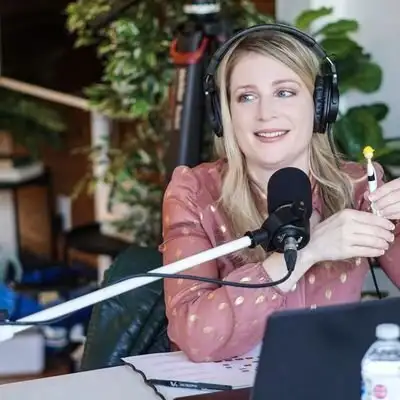
Well, and I'm joining both of you
right now from our podcast lounge,
so this is the space I presented on.
Neil McPhedran: That's great
Emily Sikora: And empowering students
to record on their own terms, it's
really-- So yes, like I've built this
physical space, and there's technology
and stuff, but it's really a mindset
shift of bringing students into a
space and not having the technology
be the first thing on their mind.
I want a student to come into a
space like the podcast lounge and be
empowered to look beyond the tech and
just focus on their message and focus
on what they've come here to create.
So really just doing what I can here
to nurture that feeling of empowerment
and like, "Hey, I've got this,"
and it's not this big, scary thing
Neil McPhedran: That's great.
So we, we can see you in, in there in
the studio if you're watching on video,
but maybe just sort of give us the bigger
picture of what is the, the Podcast
Lounge, and how, how does it all work?
Emily Sikora: Absolutely.
So, the Podcast Lounge is
this space at Penn State.
I'm housed up at our University
Park campus, so we have about
40, 50,000 students on campus.
And the Podcast Lounge is a
space that's open to all of them.
All students, faculty, and staff can use
this space to complete their projects.
The Podcast Lounge is part of my team,
Media Commons at Penn State which
even bigger, is part of Teaching and
Learning with Technology at Penn State.
how we operate this space and
all of our Media Commons services
is faculty can reach out to us.
They will usually bring a class here.
That's how students might find out about
the Podcast Lounge to get started with.
But beyond those direct faculty and
class partnerships, students are
making appointments individually
to use the Podcast Lounge.
actually, right before I jumped
on here with both of you, I had a
student in here working on a project.
She schedules online, sees
the live availability, books
to come and use this space.
When she's here for that appointment,
I start with 10-minute overview.
I think in my talk I call this
15 Minutes to Independence.
And I give an overview of the
space, and I try toeally break
down and simplify the tech.
Again, that's a huge priority.
Um, and then I just make sure that they do
feel confident, they do feel independent
when they're in here in this space.
And then they get off and they
start recording and creating.
Jennifer Lee: I love that because I
think a lot of people are just scared to
crack open a microphone, which is fair.
And I, I am gonna bring it back to
being in radio because Neil loves
that on everything that I say.
But that was the scariest part.
At least we don't have big
boards like we did back in radio.
When you're learning, there is a massive
board, and to be honest, I don't know
why they have it, 'cause you touch,
like, three buttons your whole career.
But you would go in and see this
gigantic board and be like, "What
do I do?" Now you don't have that.
For podcasting, you can have broadcaster
boards, and they're smaller, and
you can have people help you.
That is such a luxury, too, that you
have someone like an Emily helping
you, because you usually don't
get that when you are in radio.
So I think what you guys built is
great, and I love doing video podcasts.
You're, like, I think number
four or five that we're doing.
But I would encourage everyone, if they go
onto the video version of this, to check
out Emily's space 'cause it looks so good
Emily Sikora: Oh my gosh.
Thank you so much, Jen.
And I can definitely relate to
that overwhelm of the board.
I don't know if we got a chance to talk
about it at PodCon, but I came to Penn
State, I was a news producer um, live TV.
And um, so y- you know, I'd
be writing out the whole show,
all my blocks, the content.
Then you go into the director's
booth, and you have the board.
And same thing, I think I only had two
buttons I ever touched, and everything
else was just like cognitive overload,
like unnecessary, not helpful.
And I think some of those
experiences definitely influenced
the podcast lounge here.
Talking about the setup, like right
now, if you are watching us on video,
you see me from our main camera.
This is the main shot.
But I have two side cameras so that,
again, enabling that confidence
and independence, a student could
just grab this stream deck here
and just change their camera
angles which they love doing that.
It's so fun.
And yeah, That's inspired
by live production
Neil McPhedran: we're hearing more
and more as, I think, institutions
and, and higher ed is getting into
podcasting, and we're starting to
hear about institutions that are
starting to build podcast, studios.
I'm curious though, because I
think there's a lot of faith that
people are gonna, gonna show up.
So maybe just sort of take us
through some of those early days.
Like, did people show up?
Did they… Maybe just walk
us through what happened
when you opened up the doors.
Emily Sikora: Well, before even
the pitch, I love podcasts.
You know, I've always
listened to podcasts.
Now with video podcasts, I'm
always watching podcasts.
I'll be at my desk, I have something
on in another tab, you know?
It's a great way to always be learning.
But I knew that I couldn't pitch it, like
creating a space like this, just because I
love podcasting and I think it's cool and
I think people will like this, you know?
I had to be a little bit more
grounded, my feet on the ground
when I brought this to the team.
So I looked at, you know, can I build this
space and actually solve a problem instead
of just building it to build it and like
you were just saying, Neil, like kinda
like, "Fingers crossed, I hope they come."
so I looked at some of the faculty
we were already working with at the
Media Commons and the assignments that
they were assigning their students.
One of those assignments for a public
speaking class actually, was at the
end of every semester, they had this
reflection assignment where they have
to come together, meet as that group,
and actually break down their group
dynamic over the semester, so evaluate
themselves and how they worked together.
love That assignment.
If you've ever worked on a group project,
you know, accountability is tough.
And so having this like looming thing
at the end of the semester where we
have to talk about if we did a good
or bad job, I think that was awesome.
But we didn't have a space that could
capture what that faculty member
really wanted to capture, which
was a group discussion on video.
We were putting students into spaces
where they had one, you know, the
round snowball microphone on a table.
They used the iMac camera
that was built in, the webcam.
And So I looked at that as
really like my case study.
I was like, "If I could give
this faculty, this class, these
students a solution, what would that
look like?" And it's podcasting.
Essentially, they needed a space
that was good for podcasting
because it's a conversation.
It's a group discussion.
They want a camera.
They want a good sound.
I have a film background.
My degree is in film production, so
I'm also really aware of the visuals.
And I was like, "I need everyone to
be at a rounded table so they can
also see each other, but the camera
can see them." So really, I first
identified the problem, came up with
Podcast Lounge to solve that problem.
So when Podcast Lounge launched,
successful right away 'cause I had already
identified partners and collaborators
in faculty that we could work with.
And then it was word of mouth.
Faculty were telling other faculty.
I held an open house, and I got people
in here in the lounge with me and I
recorded mini podcasts with everyone.
I think I was just asking people
what they had for breakfast.
And as soon as they put the headphones
on, they're speaking into the
microphone, they can hear themselves, see
themselves, was like this ah-ha moment.
And they started coming back
to me with all these cool
ideas about what they could do.
"Oh, I could interview faculty in my own
department who have a new book they've
just published. We can have students
talking about the Penn State journey."
since then, we've partnered with colleges
and departments across the university
and it's just been really awesome to
see it grow and really be embraced
Jennifer Lee: That's so awesome.
So obviously very
successful, not surprised.
People are coming, but I
want to know, this is a tough
question, are people coming back?
Because there is the dreaded pod fade.
You have all this sexy equipment.
You get to hear yourself
in the headphones.
You get hooked, but do you
continue is what I want to know
Emily Sikora: Yes.
Great question, Jen, and the
answer is yes, they're coming back.
I'm having faculty come back every
semester 'cause they've introduced a
new podcasting assignment, and it's
been so well-received by the students.
For students, it's such a
nice change of pace, right?
Instead of write 1,500 words, now
come into a space with a bulleted
list of what you wanna talk about
and have a 10-minute conversation.
They're just really preferring that.
Students are consuming podcasts in
levels, like, unprecedented, right?
With the video end of podcasting
now, just loving podcasts.
So they also love coming into this
space and being a creator themselves.
I've worked with faculty members
who are coming in and doing
podcasting for the first time, right?
So maybe what you're saying, Jen, right,
it's like, it seems kind of sexy, it's
kind of cool, you know, and they come into
this space, but then they realize, like,
this is really a grounded practice, and it
really enhances the learning outcomes that
they're aiming for in their own course.
I have individual student
groups who are coming back.
We have our Penn State Blue Band.
Some members in there have launched
a Penn State Blue Band podcast.
That's our
Neil McPhedran: Cool
Emily Sikora: marching band on
campus, and their podcast is
called For The Glory, shout-out.
And they come back.
They're starting up recording for
this semester next week again.
We have our admissions team who
actually works in this building right
upstairs, so very convenient location
for them, and they've launched The
Roar Room, asking students to share
their Penn State journey, having
faculty share what students could
expect if they come to Penn State.
So just so excited about
all of the connections.
I'm so excited about our return folks
and I'm every day just so excited when
someone comes in here for the first time.
Jennifer Lee: See?
You're so passionate.
There's no podfade.
Emily Sikora: Yeah.
Jennifer Lee: No podfade in the lounge.
Emily Sikora: Whoop whoop.
Neil McPhedran: No pod fade.
That's so great, Emily.
Just, it, it really sounds
like a, a scenario of if you
build it, they will come.
I think it was great how you shared,
like you did your homework up front
and you proved up front that there was
a demand preexisting, but it sounds
like there's, there's, there's just
an unknown demand that a wh- a whole
bunch of people of, and, and faculty and
whatnot have just found the space, and
then it's now part of their curriculum
or the student group that, or the
marching band you're talking about.
I just think that's, that's a really
interesting takeaway for those out in the
audience that are listening to this and
might be considering something like this.
I, I presume you've, built a, a module or
something like that, but maybe just sort
of give some people some tips if they're
considering building a space like this.
Like, what they also might wanna
consider as far as, I guess,
staffing it and the training and
the everything else that comes along
with, with building a space like that.
Emily Sikora: Absolutely So when I was
thinking about, you know, the Podcast
Lounge at first I started thinking about
that whole flow that a user would have
from, you know, starting with how do they
even find out about the Podcast Lounge?
When I was an undergraduate student,
I was very shy and I was very timid.
And if I didn't really know how a
space worked or what I could expect
when I went there, I usually just
didn't go and explore things if I
couldn't find the answers online.
So I was like, "Okay, let me start
with really good web presence." So
before launching, I made sure that
I had a really fleshed out webpage.
I got some early collaborators in here
who agreed to let me take photos of
them smiling like they were having the
time of their life, which was great.
So then I had content.
I could flesh out the
Podcast Lounge webpage.
I created a very short
little overview video.
I was using that to kind of
socialize the lounge to people.
I was sending that video around.
That's on the Podcast Lounge website.
So when you start to even look at
the lounge or you're thinking about
making an appointment, that webpage is
probably where someone first starts.
Since launching.
Neil McPhedran: Really good insight.
Emily Sikora: Yeah.
Thank you.
For since launching first lounge,
which is the one I'm in right
now, I launched a second one.
Then I was able to build out that
website more with pictures of the two
lounges, the differences between them.
Then I started featuring student,
faculty, and staff projects on the page
really just helping people brainstorm
what they might be able to create also.
I even have an episode from
Jenna up on the page there.
so that's the start of of some of the
planning that goes into this space.
Once they actually go ahead and make
that appointment and they're here
in the physical location the Podcast
Lounge is supported by myself, and more
recently, I've had an incredible student
worker, Kiana, join the team over here
in the Shields Building Media Commons.
Kiana is fully trained on how to
support users of the Podcast lounge.
and she does an incredible job.
She loves engaging with all the different
people that come in, and she herself
feels very confident troubleshooting and
helping people get set up with the space.
That actual setup when a user is
in the Podcast Lounge I've got some
printed instruction in the space that
they can keep on hand once we leave,
and then they can go on their own.
But before that happens, I do have kind
of the written out things that, like
myself or kiana, or someone else would
go over with someone in this space.
Which is really get them in the seat,
show them how to position the microphone
I usually do like a little hang 10.
I explain you've got three cameras, press
these buttons to change your cameras.
And then I say, "Okay, now put on
your headphones." And they put on the
headphones and I say, " How was your day
today?" And they go, " And then usually
they say, "Oh, I should do ASMR." which
is so-- They start petting the microphone.
It's-- And I love that.
I just love the fun energy and
immediately how they start having ideas.
And that's, that's really the
overview is just kind of here's
the space, now put yourself in it.
Start creating.
Jennifer Lee: Was the hang
10 for mic distance, Emily?
.
Emily Sikora: Yes, it is.
Jennifer Lee: So funny because I've
never heard anyone call it that.
I always say, because this is when
I learned in broadcasting is it
was the telephone, but now I have
to tell people it's the old school
telephone because they won't know.
The kids will be like, "This is wrong."
And so I never thought
about hang 10, but yeah.
Neil McPhedran: Jen.
Hang 10.
Jennifer Lee: Hang 10.
I'm more cool now thanks to Emily because
I say old school telephone, and they
look like I'm a psycho, but it's fine
Emily Sikora: I am so happy to
share my insightful tips and tricks.
Neil McPhedran: and
then what about editing?
Are you then providing guidance,
like so record an episode or,
and then, and then now what?
So are you then providing guidance
on editing and all the next steps
to stand up a podcast as well?
Emily Sikora: Yes.
So here at the Media Commons, not
only do we have physical space
like the podcast lounge, but we
also teach a range of workshops.
I'm one of the full-time consultants.
We have five consultants.
have a whole workshops page on the
Media Commons website, and we have,
right now we've got two different
workshops all about podcast editing.
We're working on a third one now that'll
be even more kind of beginner intro
level because we have a new tool here
at Penn State and that's really great
for the very like, "I don't really
need that heavy tech. Like, I don't
need multiple audio channels. I just
need to, like, make a podcast." So
we're always looking at what new tools
are coming out so that we can help
deliver those tools into the classroom.
And so that's an example of where
a faculty member might reach out to
us and say, "Hey, I wanna do a whole
podcast assignment, but I'm not the
subject matter expert in podcasting
and audio editing. Can you help?" And
that's where we come in, so then they
can schedule that workshop to happen
during their regular class time.
We have a 40-person iMac computer lab
that they can bring their students to.
We have projectors all around.
So as I'm doing a live demo of editing
a podcast, all the students are working
with me in real time and actually
going through an editing workflow of
podcasting, and it's pretty awesome.
Outside of the workshop, then a student
can make follow-up appointments and meet
with us individually for continued editing
help or individual project-specific help.
Neil McPhedran: Well, Emily it's just
amazing hearing about all, all this quite
incredible ecosystem of podcasting that
seems to be, happening at Penn State.
how do you see this all coming together,
or what's your next step, do you think,
now that you've, you've got all this
stuff started for, on the podcast front?
how do you see this
evolving at Penn State?
Emily Sikora: Yeah.
So I really, like you've pointed
out, it feels like podcasting is
kind of taking over at Penn State.
It, you know,
Jennifer Lee: through
Emily Sikora: the Media Commons,
I'm seeing it be integrated into
so many different colleges and
units and disciplines in all
very cool and very unique ways.
What I would love to see happen next
is kind of an organizing of all the
different podcasting efforts, you know?
' Cause we have staff who are
creating incredible podcasts.
We have faculty who are
deep into podcasting.
We have students creating so many
different student-led podcasts, and
it would be amazing to see one space
where those kind of all come together
so that, you know, everyone at Penn
State can see all of the incredible
efforts happening across the university.
Neil McPhedran: That's great.
I think, I think that's a challenge
that we've heard from a lot of
different universities as well too,
just that whether it's creating a
network or just sort of pulling it
all together, there seems to be a lot
that's going on in different corners of
different, of different universities.
So, keep us up to date on that because
I think other people are trying
to tackle that challenge as well.
Jennifer Lee: Yeah.
I think that's the thing is that
we gotta remember that a lot of
these campuses are so massive too.
So it's really hard for one
person like Emily to know every
podcast that someone is doing.
So I think what you do is so great in
trying to assemble everybody, so because
we wanna hear about your podcast.
So that being said, Emily, is there
a favorite story of the Podcast
Lounge that you have where you
helped somebody create their podcast?
Emily Sikora: Oh my gosh,
that's such a good question.
My mind is racing right now.
Neil McPhedran: your
favorite child now, Emily
Jennifer Lee: Yeah.
A- and you're putting
it on the record, sorry.
Emily Sikora: I know, on the record.
Oh my gosh.
Well, let me say, I love everything
that has come out of the Podcast Lounge.
You know, everyone's
brilliant, incredible.
But I will say, there was one day that
was really cool for me and it was kind
of towards the start of Podcast Lounge,
and it was group of students who do
"For the Glory," the Penn State Blue
Band podcast brought in a special guest.
And I was so excited about this guest.
This guest was Ellie Sheehan,
our first female drum major
for the Penn State Blue Band.
And if you know anything about the
Penn State Blue Band, you know how
massive the role of drum major is.
That's the person who, you
know, you're like the lead.
You're leading everything.
And on the field at our massive Penn
State football games, the drum major
runs out and does a flip on the field.
like, they have the big
hat on and everything.
And this interview was just
after Ellie had successfully
nailed that for the first time.
And so, I think seeing her come into the
lounge in this incredible student-led
podcast, I really had goosebumps 'cause
I just, you know, it made me realize
that this is all real, and it has real
value and real impact, and there's a
lot of meaning that's happening and
coming out of the Podcast Lounge.
So that's my answer, thanks.
Jennifer Lee: Not to add more hats to
everything that you do already, but
now I'm like, I feel like there needs
to be a series called The Stories
Behind the Lounge A podcast by Emily.
Yeah, I like it
Emily Sikora: That would be so fun.
Well, I do have some podcast ideas
that are bubbling and I will share them
with you both if they come to fruition.
Jennifer Lee: That sounds good.
Also, I wanna know, can you
do a flip and play the drum?
Because I definitely cannot
Emily Sikora: No.
Neil McPhedran: Yeah that's impressive.
Emily Sikora: The answer is no.
Quick answer, no.
Jennifer Lee: I'd break something.
Awesome.
Thank you so much, Emily, for coming on.
And we look forward to having you
back on and hearing more stories.
'Cause I know your counterparts,
Jenna and Katie, have been here a
few times on Continuing Studies, so
Emily Sikora: And when you reached
out, I asked, I was like, "Did
you guys have a good time?" And
they said, "Oh, it was awesome.
You're gonna have a blast." And it's true.
I'm gonna text them after this.
Jennifer Lee: Perfect.
Neil McPhedran: Well, thanks so much.
That's great
Emily Sikora: Thank you both so much
Neil McPhedran: Well, Jenn, I really
enjoyed that conversation with Emily.
She is great.
And I know we didn't say it
in the episode, but I said
it to her after we tuned out.
She also has a great podcast voice
Jennifer Lee: She does.
I definitely think she's
got a really soothing voice.
But what I loved learning from her
was just how great she is when people
come into the podcast lounge and
she teaches them how to podcast.
And I think that's why it's successful,
because you mentioned it earlier on the
episode, is you can build something, but
it's not necessarily people are gonna
come and use it and continuously use it.
So I just love the fact that she
comes in and she really helps people
understand the process of podcasting
Neil McPhedran: Yeah.
I think the, the, the other part
was it's not just about building the
studio which is great and it looks
good and it's, it's quite incredible
what, what, what they've built there.
But it's the other stuff around it.
So I, I'm glad that she mentioned
the website, which is great.
It's a really well put together
website, but also that really helps
because that's the kind of the first
place we go when we're looking for
something or we hear about something
on the campus or something like that.
So that's excellent that, that she's put
that together and it's just incredible
actually, what can happen when you
build a facility and really a resource
where it's, it's, you know, it's
Emily and her colleague there bringing
people in, but it's just incredible
what can come out of it and, and it's
now a, you know, it's a teaching tool.
It's for students.
It's for faculty to use for their
own podcasts and so on and so forth.
And yeah, I think it's just, it's
real testament to kind of as I said,
if you build it, they will come
Jennifer Lee: Yeah.
But that being said, you just
can't build it and they will come.
She did so much research.
And that's I think, a lot of things
that are lacking nowadays is, yes,
everyone wants to do a podcast, which
is great, but a lot of people don't even
think about how they're gonna start.
Same thing with a podcasting space.
lot of people are popping them up
many places, which is fine, it's
a great thing, but you gotta think
about how is this space gonna be used.
Just because you put in amazing product
doesn't mean people are gonna use it.
So how do you get them to do that?
Well, she has definitely figured that out.
So thank you so much to her for being
on the podcast, and thank you for tuning
in to the Continuing Studies podcast, a
podcast for higher education podcasters.
We hope you found this episode
informative and inspiring.
If you enjoyed the show, we encourage
you to follow and subscribe to our
podcast on your preferred platform
so you'll never miss an episode.
But if you found this episode
particularly valuable, please consider
sharing it with your friends and
colleagues who also might be interested
in higher education podcasts.
We also invite you to join your peers on
HigherEdPods.com, where you can connect
with other podcasters in higher education
and learn from others in the field.
Thank you so much for being
part of our community.
We look forward to continuing to bring
you valuable insights and conversations
around higher education podcasts.
See you in the next episode
Creators and Guests