From the Classroom to Industry Jobs: Inside a Master’s Program in Podcasting
Neil McPhedran: So it really set you
both up for careers in podcasting.
It wasn't just sort of a academic.
Theoretical program,
it was very practical.
Max'ed Aadan: Absolutely.
I think from the first day we
started, we were immediately
kind of thrown in the deep end.
Like Chloe said, if you had no
experience going into the course,
you could immediately get started
with audio production, learning
how to edit, how to soundscape
with the technical production side.
And if you did have that experience to
begin with, there were other elements
you might not have been familiar with
that you could explore straight away.
So I think it did prepare you
quite well for whichever kind
of lane you wanted to go down.
Whether you wanted to be an independent
producer yourself, whether you
wanted to behind the mic work in
the marketing side of things, or
work in a big production company, or
even the BBC those kind of avenues
were open to you from the beginning
Chloe Sackur: And I might just add that
actually one of the appeals to me for the
course was the fact that they have this
placement scheme for all of the students.
There was a variety of organizations
who were open to having us come for
one day a week and work for them.
A few people have then gone on to work
for those companies, myself included.
Neil McPhedran: Welcome to Continuing
Studies, a podcast for higher
education podcasters who want to
learn, connect, and get inspired.
I'm Neil McPhedran,
founder of HigherEdPods.com
and Podium Podcast Company.
Jennifer-Lee: And I'm Jennifer
Lee, founder of JPod Creations.
If you're podcasting in
higher ed, you're not alone.
There is a fast growing
community out there and we're
here to help you tap into it.
Neil McPhedran: Totally right Jen, and a
great place to do that is Higher Ed Pods.
Make sure your podcast
is listed in our library.
You know what, Jen?
I had a really awesome phone call
last week with one of the directors
at the London Podcast Show, and
it was just inspiring to hear she
found us through this podcast.
I just love that, people
listen and they reach out.
But they're really trying to,
the London Podcast show that is,
tap into more university, higher
education podcasters and students.
We've got some news.
I'll be able to share more
about that for our listening
audience in the coming weeks.
Jennifer-Lee: That's so awesome, because
obviously we know this from a broadcast
background and after going to broadcasting
school, there's different jobs you can
go on to get with podcasting, since
it's still relatively new, it's neat
to see that we're seeing all these
different job opportunities come out and
we, we haven't really talked about it.
We've talked about school
education and the podcast
programming, in London with Brett.
If you haven't listened to the
episode, take a look at it.
But we have two of his students
on today to go deeper into that
program and talk about the jobs
that they got out of graduation.
Neil McPhedran: Yeah, that's right.
So today, we are chatting with
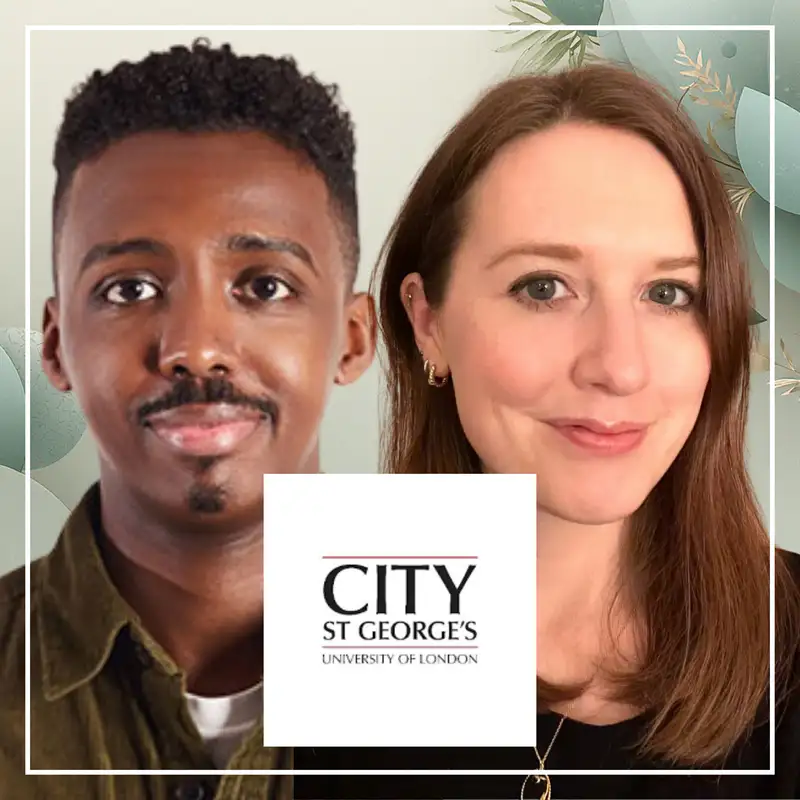
Max'ed AAdan and Chloe Sackur.
They are both recent grads of The City
St. George, University of London Master's
program that they have in podcasting.
And it's really inspiring to hear
how practical of a program they've
built at St. George University and
to your point that the students
are coming outta there, into jobs.
So let's get into our conversation.
Jennifer-Lee: Sounds great.
, Neil McPhedran: Welcome it's
great to have you here.
Chloe Sackur: Thanks for having us.
Max'ed Aadan: Yeah, it's
great to speak with you both.
Thank you.
Neil McPhedran: So we had Brett Spencer
on a previous episode and he gave us
a bit of a deeper dive into the MA
in Podcasting program at the City of
St. George's University of London.
But maybe for those who might
not have heard that episode.
Although I would recommend anyone to
go back and listen to that episode,
just if you could give us a quick
snapshot of, of that MA program.
Chloe Sackur: It's basically a
primer for everything to do with
podcasting and radio as well.
We could join the course even
if we didn't have any background
in broadcasting or anything.
I didn't have that.
You learn everything from those
technical skills like editing audio
and making social video to things
like audience strategy and marketing
and developing series ideas.
Uh, pitching.
There was also a journalistic element,
we took classes and had to sit an
exam in media law and uh, do tests
and ethics and things like that.
So it is quite a wide ranging course,
but it's also very creative and
Max'ed and I made various podcasts
together and with the rest of the
group, so it was really wonderfully.
Broad and wide ranging,
Jennifer-Lee: And you guys were both doing
something too before this whole thing.
So Chloe, you were working in publishing?
Chloe Sackur: Mm-hmm.
Jennifer-Lee: And Max'ed you actually
got a Spotify scholarship as well.
So can you tell us a little bit about that
before you guys even entered the program?
Chloe Sackur: So, yeah, for a
long time I was in publishing.
I was a children's book editor.
I still do a bit of that.
Yeah, for me, the attraction of the
course was very much this challenge
of can I learn a whole new skillset.
I had been editing text and working on
printed media, but I had never worked
on anything to do with audio or video.
So to do something like that was this
real kind of interesting challenge, and
what appealed to me was the fact that
that course has that kind of practical
thing that can then kind of throw you
in at deep end and give you a mic.
Literally, in our first lunch
hour, we were given mics and
told go out and interview people.
And so that kind of thing,
the journalistic skills,
all of that was new to me.
Yet what was appealing to me was the
fact that there was this openness
and that's something that I like
about the podcasting industry.
I like that's quite open to the fact that
people come from different backgrounds,
Neil McPhedran: Right
Chloe Sackur: So, yes, I'm not a
journalist in the traditional sense,
but I have storytelling awareness
and knowledge from my years working
on series fiction for children.
And I kind of understand things
about voice and character and plot.
And so then it was for me to learn
all the other bits and pieces
that kind of dovetail into that.
Neil McPhedran: What about you, Max'ed?
What was your background
going into the program?
Max'ed Aadan: I originally studied
filmmaking at university, and I
worked in the film and TV industry.
Made some short films,
documentaries, worked in development.
Alongside that, I was working in
the public health service since
I was 18 while I was studying.
And I was kind of having one of
those days where I was listening
to a particular podcast.
I was quite distracted at work and
I was like, I'm not really getting
the thing that I thought I would get
out of this part of my adulthood.
So I was like, let me have a look
and see what else is out there.
And lo and behold, podcasting MA comes
up on the City University website.
And I had a look at the course and
my instinct was, I don't wanna go
back to an education program if it is
only gonna be as part of the academic
side, of learning the theory behind
it, because there are merits to that,
but it was not what I was looking for.
Neil McPhedran: Yeah
Max'ed Aadan: I had a wonderful
conversation with Sandy Warr, who
was part of the course team who also
ran the course with Brett last year.
She explained to me exactly what the
course format would be like, and the
fact that it is very practical, technical
hands-on, and it's only 10 months.
I thought, I'm gonna give it a go,
and I said to my wife at home, look,
I'm gonna apply for this course.
It's a bit of a wild card and I'm
only gonna do it if I'm fortunate
enough to get the scholarship
because it's a bit expensive for me.
I was fortunate to actually be awarded
the Spotify scholarship, which was a
huge weight off my shoulders, which
made the opportunity to study on the
course very easy for me to accept.
Neil McPhedran: That, that's great.
So there's actually an overarching
scholar program that Spotify sponsors,
and you got accepted into that.
Max'ed Aadan: Yeah, that's correct.
So you had to apply for that, make the
case for why that particular course, what
skills you have, what you can bring to it.
Essentially, it's a way of supporting
students who may not have the means
to continue on education, but we
need to demonstrate that you will be
a good ambassador, not only for the
university, but for the brand of Spotify.
And as part of that scholarship,
I was expected to participate on
the placement program with them.
And it was a huge learning experience
for me, which I really enjoyed.
Jennifer-Lee: And what made you
guys decide to get into podcasting?
Because like for me, when I went to
school, because I'm much older than both
of you, I wanted to work for the BBC, CNN,
all those traditional broadcasting spaces.
I did go on to work on some equivalents
here in Canada, but it's still a
fairly new industry and you guys are
maybe not wanting to work for the
BBC and other traditional outlets.
You're going into newer things.
Max'ed Aadan: I think for me,
I've always loved podcasting.
I came across it back in 2006.
I had run out of football content to watch
and listen to on iTunes, and I discovered
what an RSS feed was and unfortunately
that that is where my unhealthy
podcasting habits first were born.
Since 2006, I've been listening
to a wide array of podcasts.
What drew me to the course was an
opportunity to explore something
that I really liked in my spare time.
Also, the fact that it was a professional
development course, like Chloe said,
where you get to learn everything.
And essentially, yes, it's a master's
course, it's an education program, the
entire cohort, it felt like you're part
of a mini production company where you
would pitch to each other, pitch against
each other, support each other, challenge
each other, and distribute your content.
And I think that's what
drew me to the course.
That's what I loved about it.
Chloe Sackur: Yeah, you're
definitely collaborating.
I think that's a really key aspect of it.
And you are operating quite independently,
so, although of course we had assessments
to fulfill, there is this aspect of
you can do what you like, you can
make a podcast about anything you
like and put out that week, and then
you are doing an assessment around
perhaps the social marketing strategy.
Neil McPhedran: So it really set you
both up for careers in podcasting.
It wasn't just sort of a academic.
Theoretical program,
it was very practical.
Set you off on the right foot
to get careers in podcasting.
Max'ed Aadan: Absolutely.
I think from the first day we
started, we were immediately
kind of thrown in the deep end.
Like Chloe said, if you had no
experience going into the course,
you could immediately get started
with audio production, learning
how to edit, how to soundscape
with the technical production side.
And if you did have that experience to
begin with, there were other elements
you might not have been familiar with
that you could explore straight away.
So I think it did prepare you
quite well for whichever kind
of lane you wanted to go down.
Whether you wanted to be an independent
producer yourself, whether you wanted to
behind the mic, work in the marketing side
of things, or work in a big production
company, or even the BBC, those kind
of avenues were open to you from the
beginning depending on, like Chloe said,
what you were interested in and what
you decided to put out and put in your
portfolio by the time you finished.
Chloe Sackur: And I might just add that
actually one of the appeals to me for the
course was the fact that they have this
placement scheme for all of the students.
Brett opened up his little black book and
reached out to various industry contacts.
There was a variety of organizations
who were open to having us come for
one day a week and work for them.
A few people have then gone on to work
for those companies, myself included.
So, I have been working as a freelancer
for a production company called
Almost Tangible, and they're best
known for their award-winning dramas.
Quite a few produced for the BBC.
So I have ended up working for the
BBC in a very kind of roundabout way.
Um,
Neil McPhedran: Jen's very jealous.
Chloe Sackur: Yeah, so it's exciting
to be working on these things.
My first weeks in interning for
them, I was coming up with ideas,
developing ideas to pitch to the
BBC, which was really exciting.
Neil McPhedran: that's amazing.
Chloe Sackur: yeah, first few weeks and
coming up with ideas and testing 'em out.
Obviously not all of my ideas get through,
get pitched, but it's a really good
testing ground because is this actually an
idea or is it more of a starter thoughts?
And I think that's one of the things
that comes up in our classes as well.
We did a module called Pitch the
Product, which is taught by Brett.
And lots of industry people come in
and they talk about how to develop
ideas that are actually going
to get through to commissioners.
Jennifer-Lee: There's such an art to that.
You really wanna make sure that
people are going to understand your
story and where you're going with it.
How important even just speaking
and knowing when to stop and
how much information you put
into it is such a crucial thing.
Max'ed Aadan: It goes back to what Chloe
said at the beginning of the conversation,
that because the industry is so open that
you can come from different backgrounds.
And from my understanding, Brett's
worked in so many different aspects
of broadcasting, not just radio,
that I think it bleeds into what
the industry is now because it's
not just defined as audio only.
And I think we benefited from that
experience because there were so many
opportunities for us to not just hear
from industry professionals, but it
maybe go to some talks, even some of
the placements, and I think that was
kind of a big draw for a lot of us.
Neil McPhedran: Excellent.
I think that's a really big benefit to
the program, and I think any university
level program out there that's looking
to do something like this or is doing
something like this to have that exposure.
While you're right in the program,
but then that opportunity after to
help you, you know, get, get your
feet out underneath of you and,
and to have those opportunities.
Max'ed, what are you doing now
after coming out of the program?
You've had some interesting opportunities
coming out of it as well too, haven't you?
Max'ed Aadan: I'm really blessed.
I'm currently working at Goalhanger.
I'm an assistant producer on
their sports podcasts, The Rest
is Football and Daily Brightness,
and the new Spanish football show.
And that opportunity actually came
about because of the very module
that Chloe mentions Pitch to Product.
There was a particular day when we were
doing our presentations where you're
pitching the idea of the podcast that
you wanna make, but my idea, if my
memory serves me correct, it was about
a comedy podcast and one of the judges
happened to be the head of development
at Goalhanger, and we had a really
interesting conversation afterwards.
And she remembered me when later on
they were looking for some freelancers
to do some work for them, and I threw
my hat in the ring and that's kind
of how the opportunity came about.
So I did some work for them last
summer while they were short staffed
in September, I applied for a
full-time position there and I've
been working there since October.
Now.
Neil McPhedran: That's great.
I think a lot of our audience
is Canadian and American.
So when you say football,
you're talking about soccer?
Max'ed Aadan: Yes.
Yes.
Neil McPhedran: And for those
people who don't know, Goalhanger
is a pretty big deal there.
That's a big more than podcasting.
Max'ed Aadan: Well, they do a lot of
things now, live shows, festivals,
merchandising, memberships,
loads of different things.
So I would, I would probably classify
more closely to being a media
brand, media publisher, and they
kind of redefined what is possible.
Because the industry in the uk, whilst
there's a long historic track record of
making great radio and audio programs,
they've kind of broken the mold.
And it feels more akin to what you happen
to see over in North America, the kind
of global outlook that is quite fast.
Jennifer-Lee: You guys do
some really cool stuff.
Can you tell us a little bit about
another neat project that you guys got
to work on, which is the UN project?
So tell us a little bit about
how that came about and what
you guys did on the project.
Chloe Sackur: Well, that's another
thing that came about thanks to Brett.
He was in New York and he got talking to
someone and they happened to be from the
UNFPA, the agency that's responsible for
women's health and equality for the UN.
They had been thinking about
doing a podcast series, and so
we were brought on to produce it.
The podcast that we produced is
called Women's World Equity by
Design, and it's a six part series,
which was released in the autumn.
We basically split into groups.
That's the way that we
worked behind the scenes.
So there are about, so three or four
students per group who developed an
episode each based around a particular
theme that the UNFPA sourced guests for.
And they tended to be experts
in a particular field.
And I believe Max'ed, you worked
on the sports themed episode.
Max'ed Aadan: That's correct, yes.
Chloe Sackur: So perhaps
you can tell us about that.
It's on brand for you.
Max'ed Aadan: Unfortunately, I'm being
pigeonholed a little bit, but yes.
It was all about the inequities
in the world, specifically
regarding women in various fields.
So not just sports, but in
technology, in health finance.
And as Chloe said, we got to develop
and work on an individual episode.
But what was quite nice was there was
regular production and development
meetings with the UN talk about our
progress and what we're thinking
and how we're gonna develop it,
what the tone is gonna be, what
the voice of the show is gonna be.
And there was quite a lot of moving parts.
Obviously, as you can imagine,
the UN is a global organization.
Neil McPhedran: Yeah.
Max'ed Aadan: And you have to
liaise with different experts
in different parts of the world.
Sourcing the interviews themselves,
figuring out how much of this do
we include, what is the perspective
that we're trying to present here?
Speaking specifically
from the sport element.
We thought it was quite interesting
to talk, not just in the in inequities
that we've been experience in sport,
but the foundational structures
that make it difficult for women
to have an even playing field.
Things that you perhaps don't
always even think about.
Things like having equal access to
facilities, having the same kind of
consideration that goes into training
and the health and science aspect of
sports, and it was fascinating for us
to explore that in different areas.
Jennifer-Lee: I found that one
episode really interesting where
they were talking about footwear.
One of the athletes had to wear
men's shoes because women's
footwear for running is not at par.
And I was like, that is so crazy to me.
And the fact that she
couldn't fit into it.
Max'ed Aadan: There was an amazing
researcher we spoke with who speaks about
how the very foundation of the research
that gets used in sports science in
particular, most of the data set, is the
average male, the average male weights.
So all the data that's being collected
and all this understanding that we have,
that then gets put into place by the
kind of training people have to do, the
kind of regimes they have to be part of.
It's flawed from the very beginning
because the data did not include women.
Jennifer-Lee: It's crazy.
And that's many industries.
Chloe Sackur: Absolutely.
And I think that the episode I worked
on was about financing for solutions
for women, so generally healthcare, but
also that we spoke to Mariam has created
an app based around women's safety.
They were talking about the fact that
behind the scenes, when you're trying
to get financing for your idea, and it's
something that is aimed at women, perhaps
it's to do with that app, or it's to do
with research into endometriosis, which
affects millions of women worldwide.
Unfortunately, if you are a female
founder, you are often in a room with
a bunch of men who do not understand.
They don't have the lived
experience or they just.
Kind of don't care about these
issues, and so they're not
gonna open up their checkbooks.
And so it's really, really tough,
and so a tiny, tiny minority of those
startups get venture capital funding.
So it's all those sorts of things.
The hidden networks.
Neil McPhedran: Mm-hmm.
Chloe Sackur: Behind everything that the
series was also looking at addressing.
So it gave a real kind of 360 view.
Neil McPhedran: What
an amazing opportunity.
I think as we just discussed, the
subject matter of that six part series
you created, what a way to learn about
all the facets of producing a podcast
with a very real subject, a very real
output, and that international exposure
too, that sounds great, the opposite of
theory, super practical, but also very,
very real and quite a worthy topic.
Max'ed Aadan: Absolutely.
Absolutely.
I think the biggest challenge for a lot of
students, no matter what you're studying,
is by the time you finish, everybody
expects you to have a certain level of
experience to enter the workforce, and we
were very fortunate that as part of the
program, we are getting that experience
that we need to enter the workforce.
Neil McPhedran: We're at an interesting
crossroads in podcasting right now and
Max'ed, your example with Goalhanger where
it's much more than just an audio podcast.
What do you feel about where podcasting
is going, and do you feel like you've made
the right move to go through this program
and you're out the other end and now you
both have careers focused on podcasting?
Max'ed Aadan: I'm 100% certain of that.
One of the things that we spoke about was
how the industry in this country in the
UK is 20 years old, but it still feels new
and young and it's still quite undefined.
And it feels like the industry is
changing every single day because people's
habits are changing every single day.
We no longer have one TV in a home.
We have multiple screens.
We have more than five channels to watch.
So people's attentions are split and
podcasting now, thanks to video, it
means that it's essentially a TV show
that you have on your phone or on
your tv, and you can watch it anytime,
anywhere around the world.And it
has kind of changed what's possible
and how people interact with that.
I think that's probably why Chloe
and I gravitate towards it, right?
Chloe Sackur: Yeah, I think it's
an interesting one because for me
the appeal of podcast is freedom
to explore a subject in depth.
You know, that was what was
so fun because you can talk to
people who don't necessarily have
a big platform or a big name,
Neil McPhedran: right.
Chloe Sackur: About a subject that isn't
necessarily something that is going to
be prime time or you know, the BBC or
the CBC, other networks are available.
And so it's the opportunity to
go into something in great depth.
I probably have a bias towards
audio because for me, I'm very
much a person that likes to do
things whilst I'm listening and
that's how I take in information.
It's either by sitting and
reading or by listening.
I'm less of a kind of sit and watch
unless it's a film or something.
So for me.
I hope that those kind of in-depth
investigative podcasts continue
in the same vein as they have.
But I certainly agree that it's in
this kind of new stage where everything
is expanding into this visual world.
And we've had this big announcement from
Apple last week saying that they're gonna
have this kind of seamless transition.
You can start listening on your commute
or whatever, and then you get home
and you can pick up your phone and
watch it from the point that you left
off or put it on your TV or whatever.
So that sort of suggests
that they are really thinking
about that user experience.
And you know, Max'ed is right.
We are not static.
We are not doing the same thing every day.
We are changeable in our habits.
Unless you're me.
Jennifer-Lee: But think you bring, I,
Chloe Sackur: I just
headphones all the time.
Jennifer-Lee: I think you
bring up a great point Chloe.
As much as video is important, we're
seeing all these platforms changing.
I also don't think every
podcast needs to be videoed.
Yes.
We can't hide from it.
But I also don't think we
should be pressured into.
If you wanna do an audio
podcast and like some of them
lend themselves to just audio.
Like I can't imagine, like I'm sure
there would be a great documentary
that it could do, but like The
Kill List podcast, I loved it.
I binged it on a car ride, and
it is such a masterpiece because
they have all these sound effects
and everything, and it's so good.
Like I didn't need visual
to listen to that one.
Chloe Sackur: I love that podcast too.
I was a bit of a bore about it.
Max'ed can probably attest to
the fact I was like, everyone
listen to this podcast.
But I would suggest that maybe a lot
of people might not have agreed to take
part in that 'cause it's very sensitive
issues and hiding people's identity,
obviously you can do that in a TV format,
but I wonder if people might have been
less open to appearing on that if it
hadn't been in the podcast format.
For all I know, maybe they've got
another series in the works and it's
gonna be fully visualized, so I'll
have to eat my hat if that's the case.
Jennifer-Lee: I never
thought of that though.
So for anyone that doesn't know
what we're talking about, basically
there was this like list on the dark
web of people around the world that
basically you could pay to get someone
killed with Bitcoin if you wanted to.
And so this journalist in London
went and basically warned everyone.
But you brought up a
really good point because.
I don't think, yeah, because they
were still trying to figure out some
people's mysteries too, and this was
before the police caught some of the
people that were gonna kill them.
So I don't know if I really wanna watch
just a whole bunch of like fuzzy faces
Chloe Sackur: there's other
ways to make it dramatic.
Neil McPhedran: Chloe, what, what
would be some advice that you would
give prospective students considering
a specialized program like this versus
the more traditional theoretical?
Chloe Sackur: Be open to trying new stuff.
The best thing that I did was go, can I
learn new skills at this point in my life?
Yes I can.
Giving it the old college try.
I entered it with that attitude
of I'm gonna try and learn
everything, but no course can teach
you how to do it all by yourself.
You have to go away and practice.
From week one, I sat down and I just
practiced editing and I practiced
figuring out things I told myself.
Because I've never opened
up Adobe before that summer.
I thought, I'm gonna practice so that
I can build up the muscle memory.
Neil McPhedran: Mm.
Chloe Sackur: Because you need to.
You're gonna be really slow
otherwise if you don't do that.
So that was one element.
The other thing is to
just try out new stuff.
So.
I sat down and wrote a 10 minute
script for an audio drama, and
then I roped in some people,
including Max'ed to star in it.
I didn't really give you much of a choice.
I was just like, please just
play the main male role in this.
It was kind of like a romantic drama.
I paired you with another student, but in
a way your character was kind of playing
uh, not exactly a villainist role, but
you understand a bit more about him.
By the end.
He breaks the main character's
heart at the beginning.
And so, I thought I'm gonna do
that just 'cause I wanna learn
how to soundscape an audio drama.
Neil McPhedran: Mm.
Chloe Sackur: And I'm gonna go
out and I'm gonna try and record
as much of it as I can myself.
I possibly bit off a little more than
I could chew, because I had a lot
on and I had to try and soundscape
and edit and record and everything.
It's very hard to direct
and record at the same time.
If I were to do that again, I would
get someone to be a recordist.
But we live and we learn.
It's about trying stuff.
I may not know that I have.
All of the experience and all of the
knowledge quite yet, but I'm not really
gonna get any further until I grab
that mic and I just go out and do it.
Allowing yourself to not be perfect, that
is really important and that's something
that I'm continuing to remind myself with.
A podcast that I make with a friend
called Total Nineties Recall, twice
a month we record a podcast together.
We know that we're not gonna speak
like BBC presenters, but we are
going to hopefully get some good
material out there and edit it later.
I think it's about allowing yourself
to experiment and improve over time.
Neil McPhedran: Max, any bits of
advice for prospective students
considering a program like this?
Ways to judge various podcasting
programs at the university level?
Max'ed Aadan: I think the first thing
I would suggest is to speak to the
people that are running the course
the other course leaders or module
leaders, don't be afraid to send them
an email and say, I'm interested in
this course, even if it's months before
the deadlines of applying for anything.
You're not gonna be held to your word.
So even if you're just exploring it, ask
them all the questions that you have.
How does this work?
What's the program like?
What's the process for this?
Because a lot of the time, university
perspectives online, they're very
flashy and they're enticing and it all
looks great, but you might not know
exactly how it works in practical terms.
And once you understand that, then you'll
know whether it's the right place for you.
Know why you're going to do it, because
anytime you go into do higher education,
it's quite a lot of investment, not
just financially, but your time.
You could be doing anything else.
One of the things I loved about
my experience at City, was the
collaborative nature of everything.
Working on a module that then turns into
a passion project and then continuing it
on even though we have deadlines 'cause
we really enjoy the work that we're doing.
Also exploring what other
people's interests are.
If you're working in a technical capacity,
somebody else who has a totally different
interest to you might show you something
that you weren't considering before.
And don't be afraid to change your mind.
I went into the course thinking one thing
about myself and what I would like to do,
and by the time I finished it all changed
and I was really grateful for that.
Jennifer-Lee: Yeah, and I think being
flexible, like you said, when I went
to school for radio, I would've never
thought that I'd owned a podcast company
because I was very young when I was there.
And your course gives you a good base,
but you really gotta be adaptable.
And being able to know what's coming up
and the trends and being able to shift.
Max'ed Aadan: Say yes to as many
things as your time allows you to.
The more you say yes to things, not just
for the course, but a colleague will
mention, oh, I'm doing this project,
would like, would you like to help me out?
Say yes.
Then look at the message boards.
See what people are looking for help
with, try and do it all because whether
it's 10 months, couple of years, time
will fly and by the time you finish,
you'll be out in the big world and
you'll be busy working and you won't
have those opportunities again.
Chloe Sackur: Mm. I'd also just add
that when it comes to electives, we
had to choose ours pretty early on.
I think before the course started even.
I took investigative
and it was really scary.
I didn't know what I was doing.
For half a time I regretted it and I
thought I should have done film and tv.
That's what I wanna do.
But once I started to get to grips with
it, I produced something I was quite proud
of and I found out some interesting stuff.
So throwing yourself in the deep end
is worth doing rather than staying
in the shallows where you're used to.
I had to publish things on TikTok.
I was terrified.
Haven't done it since, but I really
had to dig deep and engage with social
media platforms I was not used to.
Jennifer-Lee: What advice would
you give to people coming out
as students and wanting to work?
Chloe Sackur: Well, that's quite a
tricky one because it is a tough time.
I suppose, and it's advice that I
need to keep in mind as well, is I
think it's about trying to really
meet as many people as possible in the
industry and have conversations with
people where you approach it as asking
for advice or finding out about that
person rather than asking for a job.
And I think, my first summer after
finishing the course, I've sent off
lots of emails to various companies
being like, I really love what you
do, blah, blah, blah, blah, blah.
Do you have any work?
And it just wasn't going anywhere.
And so probably the best thing
for me was just reaching out to
people through LinkedIn or we have
a network and just sort of talking
to people and asking them about
themselves and what advice they have.
And you never know how these
things will kind of all link up.
I'd say.
It's very much a contact based industry.
Max'ed Aadan: I think that's
very astute advice from Chloe.
The other thing I'd mention is
if the field you're trying to go
into, it's a technical field where
you have to prove your skill.
There's no harm in proving
your skill by building a
portfolio with passion projects.
Your friend wants to start a podcast.
Great.
Do the technical side for them,
record it additive, help produce
it, build a portfolio of work so
that when the opportunity does
arise and somebody says, I do have
an opportunity, what have you done?
You can say, these are the
skills I have and this is how
I can demonstrate it to you.
And most of the time people know that
as long as you can do this skill,
people will take a chance on you.
You just have to try and get
that as much as possible.
Jennifer-Lee: Mm-hmm.
That's great advice.
Neil McPhedran: That was great.
Thank you both so much for joining us
and for sharing your experience.. This
was a great conversation there's a lot
of takeaways for the audience here today.
Thank you so much.
Chloe Sackur: Thanks for having us.
Max'ed Aadan: Thank you for having us.
Yeah.
Jennifer-Lee: Neil, I know you and I
have been in podcasting for a bit, but I
really think we should take that course.
I'm really inspired after
talking to Chloe and Max'ed.
Neil McPhedran: Yeah,
what a great program.
It's really interesting to dig into.
The teaching of podcasting.
So often we're talking about
podcasting being used for alumni or
for recruitment, or for a professor
or for educational purposes.
So this was a great episode where we kind
of flipped it a bit and focused on the
teaching of podcasting in a university.
Jennifer-Lee: Love it.
Okay.
Thank you so much for tuning into the
Continuing Studies podcast, a podcast
for higher education podcasters.
We hope you found this episode
informative and inspiring.
If you enjoyed the show, we encourage
you to follow and subscribe to our
podcast on your preferred platform,
so you'll never miss an episode.
But if you found this episode
particularly valuable, please consider
sharing it with your friends and
colleagues who also might be interested
in higher education podcasts.
We also invite you to join
your peers on higheredpods.com.
Where you can connect with other
podcasters in higher education and
learn from others in the field.
Thank you for being part of our community.
We look forward to continuing to bring
you valuable insights and conversations
around higher education podcasts.
See you in the next episode.
Creators and Guests