Innovation Fuel 2.0: The Evolution of Podcasting in Case-Study Learning
Neil McPhedran: Welcome to Continuing
Studies, a podcast for higher
education podcasters who want to
learn, connect, and to get inspired.
I'm Neil McPhedran, founder of Higher
Ed Pods and Podium podcast company.
Jennifer-Lee: And I'm Jennifer
Lee, founder of JPod Creations.
If you're podcasting in
higher ed, you are not alone.
There is a fast growing
community out there and we're
here to help you tap into it.
Neil McPhedran: That's right Jen.
And for Higher Ed Pod Con in
July in Cleveland, the cutoff for
speaker submissions is the end
of February, so that's coming up.
We've got a whole bunch of really
good ones in, but 'cause we're going
to two days, we've got that many more
slots and so get your submissions in.
The website, higheredpodcon.com
has all the details.
If you have any questions,
happy to answer it.
If you're thinking about something
and you're not quite sure, reach out.
I would love to chat with you about this.
Jennifer-Lee: Yeah.
And.
Ideas as well for the show.
If there's anything that, uh,
Neil McPhedran: our show
Jennifer-Lee: but our show,
we'd love to hear from you too.
And speaking of ideas for Higher
Ed Pod Con , actually one of our
guests today is going to submit.
I'm really excited because we
have people that we interviewed.
I wanna say they were
one of the first five,
Neil McPhedran: one of
our first five episodes.
Jennifer-Lee: Neil and I have
worked with them since on
their podcast Innovation Fuel.
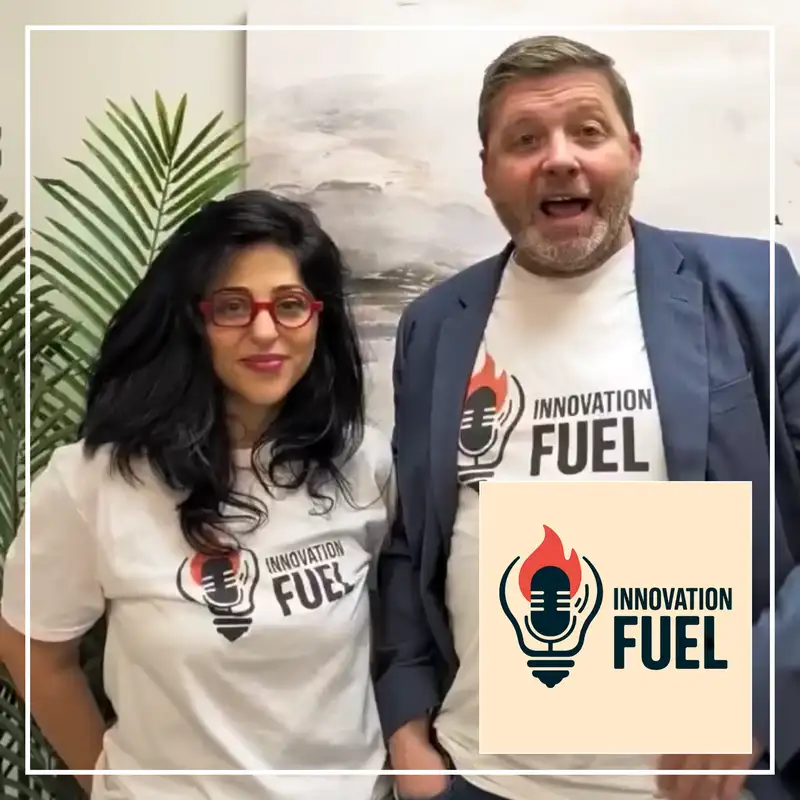
So in this episode we talk to
Dave Keighron and Dr. Gelareh
Farhadian, who has had Innovation
Fuel, the podcast for five years.
They were working under
University Canada West.
I've been with them for over four
years, bringing their podcast
to life on the production side.
Neil McPhedran: The last four have have
been much better than the first season.
Jennifer-Lee: Oh, thank you.
That was a great answer.
Good answer.
This is co-host synergy and that's what
I learned about Dave and Gelareh, they
have great co-host synergy as well.
And Neil, you've even helped us recently
do the big move because it was time to
move on from University of Canada West
and Neil, along with the awesome people
at Podium Podcast Co, and JPod Creations,
and we moved them to be their own entity
where they've created their own business.
So
Neil McPhedran: yeah, that was quite
the projects actually, Jen, you've
recently helped them make another move,
which has moved their hosting over to
TrueFans, Sam Sethi's new hosting product.
I think that's super exciting.
Jennifer-Lee: Yeah, I'm really excited.
Sam has been amazing at helping us,
uh, move it over and we're learning.
It's a good thing to learn and this
is something for our audience that,
if you are creating a podcast now
with a particular institution or a
company, your podcast could change
hands or move on to different people.
And if you can't just move a podcast
simply by putting another platform.
So, lot lots to dig into
with Dave and Gelareh.
and I'm really excited because it's
been a few years and there's been quite
a few changes lots to catch up on.
Neil McPhedran: So much to catch up on.
let's jump into our chat.
Jennifer-Lee: So how are you
guys today, Dave and Gelareh?
Dave Keighron: Amazing.
Glad to be back here and glad to share
our adventure 'cause we've been on an
adventure, a lot of adventures and,
and seen some really unique stories
along the way and now we're taking
those and we're accelerating them.
So
Gelareh Farhadian: Thank you guys.
First, I want to send my condolences to my
people of Iran for this modern massacre.
Thanks for being here guys.
Thank you very much.
Neil McPhedran: Thank you for
re reminding us about that too.
Yeah.
So maybe since we last met with you
but why don't you just give us the
top line and then let's dig into
some of these evolutions that you
guys have encountered along the way.
Dave Keighron: So when we first started
this journey, we saw a gap in the
market and the gap in the market was
that we wanted these small businesses
coming in, and their stories coming
into the classroom and interacting
with students because a lot of the
domestic based product in Canada is
small businesses, medium businesses.
We wanna to bring those
into the classroom.
Fast forward from that, since we last
chatted, we had lots of success that
we've interviewed lots of different
companies that have gone on to do
some really great things and we're
like, oh my God, we gotta take those.
Tell their story further.
We need to bring those and show
how those businesses have evolved.
And Gelareh came up with a great idea
to do that and is through publication
and peer review publication.
So we brought that in and we started
taking those stories after the fact,
three, six months later, bringing them
back and then taking 'em into publication
and having them published in big journals
like Sage and Emeralds, Ivey, ILE School
of Business where we're gonna, a variety
of different places where we've been
very successful in getting these across.
And from that, we also thought, hey,
the other part that we're really
struggling with is how do we get this
back into the classroom for faculty
to be able to engage with further?
And so we've now created a thing called
Innovation Fuel Studio, where we use
artificial intelligence to bring it back
into the classroom and help the faculties
activate these cases and activate
the students in playing with them.
Gelareh Farhadian: I want to add that is,
so Innovation Fuel is started to build
cases studies, you know, that's was the
first objective of the Innovation Fuel.
So the cases studies are just a
structured narrative and showing
challenges of entrepreneur or founder
or directors on the special issues.
And then it is how we can connect
them to the theories as well.
When we start writing the cases that
was because we had those questions
around the structures, questions
that around theories as well, right?
So it was easy for us to turn them in
the written cases and go to the peer
reviewed platform like Sage, Ivey, Emerald
or Case Centers, so those are as well.
However, we know that the generative
AI come with the challenges for faculty
that they actually really, really want
make sure students are learning and
there is going to be critical thinking.
There is two mode as the day
sets a faculty mode, so they have
the case through the podcast.
Or in the teaching node of
the published case study.
So they have a faculty mode.
When they unlock the faculty mode,
they can create assignments, lesson
plans, rubrics, and also they can
build role play with the founder
or the C or director as well.
So in the student mode, a student will
say that, okay, I'm working on this case.
Automatic, the case will pop up.
And it's a summary and the link of the
case, the student can listen to that one.
They will say that, okay, now I want
to work on this, the first challenge.
And then they have to present their
recommendation to the CEO through
the ai, and they have to start
roleplaying and try to convince
the CEO of their presentations.
We try to simulate the role play with
the founder, CEO or directors, that
who was the host of the case, and
that is students will never, ever,
ever get the solutions through the ai.
They just try to convince
it with the facts data.
They can bring it from the case or
from the publicly available data.
Neil McPhedran: Wow.
There's so much there.
It's amazing sort of where you guys
have gone since we last chatted.
I wanna kinda roll back a little
bit here and click on some of
these things along your path.
'cause you've put a lot together here.
So when we chatted with you last, what
you were doing was you were taking the
traditional educational way for business
school of case studies and each one
of those was an episode, essentially.
So each episode was a case study.
Before we kinda jump back into the
AI stuff, I think what's interesting
is, 'cause we've talked about this
on some of our previous episodes here
about the scholarly output of podcasts
or your podcast being the scholarly
output, which is what you were doing.
But since we last spoke with you,
you've taken this extra step of
putting it through peer review and
getting it submitted to journals.
Can you tell us a little
bit more about that?
Like that, that is super interesting
'cause there's a lot of people
talking about that right now.
Gelareh Farhadian: There is
several ways you can do, put
your podcast as a scholarly work.
So one thing is that you find several
peer review to review all your episodes.
And they say that, okay, we, we reviewed
this episode and it's a theoretically
rigor as well, and also is academic rigor.
And then the questions are
not biased, not the leading.
So, and those are the way you can peer
reviewed your own podcast only, so that
will be part of your scholarly work.
So when you, for example, record the
episode on February, for example,
2026, in six months later or a year
later, you have to go back to that
same episode and see what was the
development of this case, right?
So that can be your story and narrative
for written cases, study as well.
And then what challenges they are
facing and the teaching note as well.
So what Dave and I did to prove it.
So we brought those written cases
to our classrooms and actually
used it and refine it to make sure
that it's doable in the classroom.
So it's a 90 minutes or it's a
going to be group assignments.
So it's very important you
test your own cases before even
thinking about it can go further.
But the other ways of doing this is,
that's what Dave and I are doing,
working on several different papers.
Papers about, for example, connecting
these entrepreneurial discourse theories.
So this is on several papers
we are either with be submitted
or we are working to finish the
manuscripts of those one sets Datas.
What is a trend, for example, regarding
SDG entrepreneurship, constraints
in BC or Canada or ecosystems, or
another paper that we are working is
about how the podcast can impact a
student learning in the classroom.
So what we did over a year, we exposed
specific classrooms with the episodes and
then we had go through this methodology
of before we ring and afters, we have
different surveys, and then focus
group with the students to see how
it's going to impact their learning.
It is really important how you can
bring those content because you are
creating lots of data and information
and content, how you're going to
connect them, how you're going to
find the dots between them, not just
on the isolated episodes as well.
And also it's because you
want those good narratives.
is really important to see what your
podcast trying to achieve regarding
the learning of the students, right.
And then it can find good data and
Dave Keighron: like Gelareh said, it's
the s opportunity for future learning.
Hey, we went through this
element over the last five years.
We peer reviewed these elements.
We'd also taking study from this element.
To see, Hey.
Neil McPhedran: Mm-hmm.
Dave Keighron: What is a better practice
for the way we can deliver this?
How can we teach entrepreneurship better?
How can we teach marketing better?
And even to the point is that we're
going, the next evolution that Jen
sort of alluded to is we have another
podcast called Marketing Corner Talks.
It's focused on marketing.
We have another podcast called Education
Action where it's focused on the
practice of education and the teaching
of experiential learning in those
elements and all with the same elements.
How do we leverage
artificial intelligence?
How do we Leverage peer review.
How do we leverage study in order to
enhance that classroom experience?
Jennifer-Lee: And Gelareh's
been so good at getting all
these papers in the journals.
Uh, I know about one of them.
Can you tell us a little bit
about how you got into London?
Gelareh Farhadian: So when we wanted
to publish a case, we, you are
thinking about which venue is your
best and can get more attention of it.
So when you publish your case,
you can see that how many people
are using it actually, right?
And also you always need a consent
from the founder as well, right?
So to publish their cases, uh, unless, for
example, many case venue, they are looking
what happened next or something that it's
not in this publicly available, right?
So if you're using something very
internal and ask the founder to tell
something in confidence to you in
this email or, but their own word,
you can use it in teaching notes.
So when you're doing it, you need to
have a concept from the founder as well.
So that was another process
and that was really good.
Dave Keighron: One other thing to
note here is that one of the things
that we're doing and what podcast
has the advantage of doing is
that we have up to date content.
One of the challenges that we face as
faculty is the content you're getting
sometimes is so way outdated that it
doesn't have any relevancy anymore.
So in this element and building these
is creating a funnel of our library or
resources of continuously updated content.
That's going to be more relevant
to students and more connected
to what their future's gonna be.
Neil McPhedran: Oh, interesting.
So do they have to pay to
put these submissions forward
for some of these journals?
Gelareh Farhadian: We
never faced this one.
So even we have these
open access journals.
Mm-hmm.
We never faced something they want to pay.
And also some venue
actually pay you to do it,
Neil McPhedran: right?
Yeah, more so they should.
And so is there a separate designation
for it being a podcast versus a written
or a more traditional monograph?
Gelareh Farhadian: What
do you mean designations?
Neil McPhedran: Oh, I just like,
like how do they categorize it?
Like, like if, if the output is the
podcast, like how does that, does
it, is it differentiated when you,
when I go into the case center, for
example, and they've sort of, of
course, so they're actively grouping
together podcasts as a scholarly out.
Gelareh Farhadian: I mean, again, just by.
You know what is a scholarly output
is, is it's about peer reviewed, right?
Yeah.
So you need someone review your
work and say that it's rigor,
it's methodology, correct?
Is it ethical?
All of those stuff, right?
So by just recording your podcast,
you cannot count as your scholarly
work unless it'll be peer reviewed.
Again, so one way of doing it is that each
podcast as we do is a written case, right?
So some of them, for example, Emerald,
they have three phase of three different
people review your work, right?
So it may, that's why it takes time.
So for example, if you submit your
case today in any platform, Ivey,
Sage, Emerald, even International Open
Access journal, I mean all of them.
It may takes minimum
six months to finish it.
Sometimes a year, right?
Neil McPhedran: Yeah.
Gelareh Farhadian: So that is a, you
may see it as a constraint for sure.
That's why it's giving this
peer review and its count as
your scholarly work, right?
Mm-hmm.
But we don't want just to stop and
wait for one year to get published.
So that's why you try
recording the episode.
And also, again, you need
to find a place that.
Review podcasts, academic podcasts.
To review episode, all the episodes
not just one episode and written one.
Neil McPhedran: Mm. Okay.
Jennifer-Lee: That's a lot of work.
Neil McPhedran: Yeah.
Yeah.
Gelareh Farhadian: It's, you
need a lot of patient.
Neil McPhedran: Well, that's the process.
I mean, overall, like for
submitting to these journals, right?
I mean, it is.
It's a system that's
been built over decades
Gelareh Farhadian: that's reliable.
That's why you can say that it is, when
something come published from them, it's
been reviewed several time, and some
people will put the stamp on set and
say that this is valid, it's reliable.
Dave Keighron: Mm-hmm.
Gelareh Farhadian: Right.
Yeah.
If the self, if it's just
the self-published, who can
say it's valid, reliable.
Who can say that?
Neil McPhedran: Interesting, interesting.
So, okay, so maybe we should, let's
dig back into the next evolution,
which is back to this AI whole
process you guys have developed.
That's super, super interesting.
So you're then taking these cases
and you've created this whole
AI wrapper around it basically.
Dave Keighron: So like one of
the challenges is how do you get
it back in the classroom again?
Like how do you get that
activated in the classroom?
And so AI technology is here
now we gotta figure out how to
use AI technology within, and,
and Gelareh makes some points.
So we've been very purposeful
and very meaningful here.
'cause.
Ethics and ethical use of this element,
and especially in institutions mm-hmm.
Has been very challenging and trying to
figure out the, navigate that element.
And so we've already found a technology
that's within AI called RAG technology,
and she can talk to you about the rag
technology piece, but how do we put
barriers around this element and still
bring it back in the classroom where
the faculty can use it to develop these
cases to to assignments, and then where
students can actually interact with it.
So.
Neil McPhedran: I love that
full circle, if you will.
So it's for the classroom and then
it's going through a whole peer review,
get it published into a journal, and
then you're taking it back into the
classroom to apply and to learn and
to probably evolve things as you go.
Gelareh Farhadian: It is.
And also just say that it is, it's
not just for faculty and a student.
Also, it has to be benefit for
entrepreneurs and CEO or founders to come
to be played the role in these ecosystem.
Right?
Another things for them, it's not only
be heard in a different platforms,
not just a podcast, but also be in
the academic journals as well, and.
They can get benefit from the
results of those, what students
provide or faculty can provide it.
And see that's, I mean, try to
resolve their challenges and also
even so, we are trying the next step.
We are building a chat
bot for our episodes.
We have the contents of all episodes.
Neil McPhedran: Smart.
Gelareh Farhadian: You can ask questions
about, for example, the challenge.
I have challenge of this, for example,
fundraising in Canada, so we can
give you the several episode that is
related to that one as well, so you
as an entrepreneur can listen to the
other entrepreneurs and see that's how
they resolved their issues in about
fundraisings and how they did it.
And the same chatbot can work for
faculty as well to find, for example,
they say that I want to have a cases
related to technology adaptation
model, and then say that, okay.
These are the cases can
be related to those.
We are in the middle of developments.
We're in testing phase.
Actually you're testing to
see what the next step will be
connecting to the InnovationFuel.Ca
Jennifer-Lee: And question, because
I know that Dave and I talked about
this before, and you see this as
something that's gonna become like a
subscription services for teachers.
Dave Keighron: Yeah.
So we're at the post that again, at
the beginning stages of this, someone
we're testing to see what really, 'cause
again, we're solving a problem and we're
trying to find solutions for a problem.
We gotta put the user in there and
figure out what works best for the user.
And I think in this early stage, yes.
Eventually we gotta figure out how
to monetize it in a different way.
And we've talked about the membership
subscription based element, but yeah,
we're still, we're still early days.
Neil McPhedran: Yeah.
Well, I, I, I think what's great is
that so often academic work research.
In this case, business, case studies
get, go into these journals and they it,
and it just stays in the academic world.
I love how you, you what you guys are
not bringing it back into the classroom,
but the point you just made, which
just really resonated with me is,
is like there's making it accessible
for outside of the classroom for the
entrepreneurs, the practical side of it.
So it's like, it's like making all
this research and these learnings and
these insights open to the general.
In, you know, audience, in this
case entrepreneurial world, which is
Gelareh Farhadian: Yeah,
Neil McPhedran: super cool.
Gelareh Farhadian: It's, it's often is
that when you look at the academy outputs
papers or cases study, maybe it won't
be much for the public audience, right?
But when it's come talking about some
narratives, it's one entrepreneur
telling their experience with the wording
of the other entrepreneurs, it can
resonate or it can be useful for them.
Jennifer-Lee: I think it's just so
cool because like you're really taking
the words off the page, and like you
said, Gelareh, you're able to hear the
authenticity of the entrepreneur's story.
You're taking it to the next level.
It's not just you reading it, it's
actually hearing their emotion.
And it's hard.
It's hard.
So it'd be nice to have
a resource like that.
And one thing before we
go, just another piece.
We didn't touch on something else.
With Innovation Fuel.
Dave, something you and I have been
working on with Innovation Fuel is
Douglas College is taking our episodes
and putting it in their library.
Neil McPhedran: Oh Cool.
Jennifer-Lee: Tell us a little about that.
Dave Keighron: We actually were involved
in a library at UCW with a podcast
before, and now they're going in.
Douglas is just taking over
and taking those further into
the library to the journal.
Gelareh's the best one
to explain how this works
Gelareh Farhadian: When you want to see
your episode in your Google Scholar,
so you cannot just add manually.
Yes you can, but it's
not very valuable, right?
So you need to have a publisher,
an academic publisher.
You're like a universities,
and they're open library.
So it's like a academic
home for your episodes.
When you have that episode, an academic
library, then automatically it'll
shows in your Google Scholar and it
can shows as your scholarly work.
Jennifer-Lee: I forget just 'cause
I'm working with a, a law on
all these different projects and
it's been really exciting to work
with you guys for over four years
and see how you guys have grown.
Neil McPhedran: But, and we'll put links
to, we'll make sure that we've, we get.
It links to everything we just talked
about here, so I think it would be
great for people to see this in action.
So how does this look in the
Douglas College Library and any,
anything you sort of wanna share?
I know stuff's in iteration, so we
probably can't share everything but.
We will share as much as we can in
the show notes, links to all this
amazing stuff you guys are building.
Gelareh Farhadian: You can find
the, I will share the innovation
field studio link with you.
However, it's so easy if you
k, go to your chat GPT and
just in the apps search for us.
Yes.
In You've got a very, yeah.
Innovation Fuel Studio just will comes up.
Neil McPhedran: Awesome.
Okay, that's great too.
Well, I think this has been
a fantastic conversation.
I mean, congratulations on so many
things that you've accomplished since
we last spoke and we're excited to
keep seeing your progress and we'll
have to get you back on another
60 some odd episodes basically.
'cause I hope you'll have to hear
how you've continued to train
the AI and to continue to move
forward with all exciting things.
You've,
Jennifer-Lee: thank you guys so much.
Thank you.
Gelareh Farhadian: Thanks.
Thank you.
Bye.
Jennifer-Lee: I'm still trying to
wrap my head around what they're
doing and I work with them daily.
I think what they're doing is amazing.
Neil McPhedran: Wow.
That was a conversation jam
packed with information.
Gelareh has so many ideas and she's
doing so many cool things, Dave too,
but Gallari really had some stuff
that she really shared with us here.
I love that.
Jennifer-Lee: I think their whole
idea is brilliant, and I think like
a lot of the people that we've had on
our podcast recently, they're kind of
cutting edge and, and they're doing the
groundwork that's gonna lead to some
really neat innovations in the future
when it comes to higher ed podcasting.
Neil McPhedran: yeah, I totally agree.
Jen.
It's interesting how our last few episodes
have really been looking at a little bit
more forward facing future and ways to use
podcasting from an academic, scholarly,
teaching perspective, and I think that's
what's super exciting about this space.
Not only is podcasting such an amazing
channel form for folks in higher
education, it is also a platform
that is part of the teaching process.
And is attached to so much that is
going on in the AI world as well, too.
Great episode.
Thank you for bringing them back on, Jen.
Jennifer-Lee: it's also neat to just
see how we're archiving history now
and we're documenting it, like the fact
that Douglas College is on board and
taking all their podcast episodes and
putting them in their audio library.
So I think it's just a really neat
thing that we're starting to see.
Neil McPhedran: That's great.
Yeah, I totally agree.
Jennifer-Lee: Thank you for tuning
into the Continuing Studies podcast, a
podcast for higher education podcasters.
We hope you found this episode
informative and inspiring.
If you enjoyed the show, we encourage
you to follow and subscribe to our
podcast on your preferred platform,
so you'll never miss an episode.
But if you found this episode pretty
valuable, please consider sharing
it with your friends and colleagues
who also might be interested
in higher education podcasts.
We also invite you to join your peers on
higher ed pods.com, where you can connect
with other podcasters in higher education
and learn from others in the field.
Thank you for being part of our community.
We look forward to continue to bring
new, valuable insights in conversations
around higher education podcasts.
See you on the next episode.
Neil McPhedran: Bye-bye.
Creators and Guests