The Art of Hosting: Live from Higher Ed PodCon 2026
Sophie White: so Priya Parker
does a lot of great work on, like,
intentional gathering, building
community, and how, as a host, you can
facilitate conversations that do that.
And the audience member who came up to me,
she also reminded me of the quote that,
"Purpose is the best bouncer,"… which I
really loved of, like, you kind of select,
you know, maybe who should be part of the
podcast or who the audience is based on
the purpose that you're trying to achieve.
I took a quote from her for the beginning
of that panel related to how hosts can
create a structure that makes guests
feel comfortable, and, you know, in
this case, guests might be podcast
guests or listeners or viewers to the
podcast who are opting to spend their
valuable time with you, so you wanna
make sure that you're, being conscious
of the time that they're giving you.
And then how as a host you can
demonstrate, I think, curiosity and
humility and making sure that you make
them feel safe as part of the conversation
and structure it in a thoughtful way.
Neil McPhedran: Welcome to
Continuing Studies, a podcast
for higher education podcasters.
I'm Neil McPhedran, founder of Podium
Podcast Company and Higher Ed Pods.
Jennifer-Lee: And I'm Jennifer-Lee,
founder of JPod Creations.
Podcasting is broadcasting.
Neil McPhedran: So
today, we are here at-
Jennifer-Lee: Yeah
… Neil McPhedran: Higher Ed
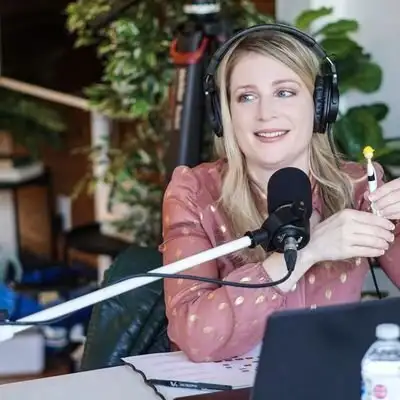
PodCon, and we are sitting with
Sophie White from EDUCAUSE.
And we had sat in on an earlier
session where she was on a panel-
Jennifer-Lee: Yeah
… Neil McPhedran: chatting about
hosting and the art of hosting.
Jennifer-Lee: One of my
favorite topics, as you know.
Neil McPhedran: It is one
of your favorite topics.
So we're gonna actually just sort of
get into that, and we're gonna cover
off a bunch of the amazing things that,
uh, she chatted about in the panel.
Jennifer-Lee: And can we just shout
out to, obviously we have our producer,
as always, Kylie, but our, uh, producer
right now for this beautiful studio, Josh.
Sorry, Kylie, you're not being replaced,
but, uh, we're happy you're here.
Neil McPhedran: Yeah, this is
such a fantastic, uh, studio
here at, uh, Cuyahoga College,
and it is absolutely incredible.
And these bright lights, I'm just
loving, and here we are on video.
Jennifer-Lee: I think we might
have to move to studio format.
Are you ready for that, Kylie?
Neil McPhedran: Uh, I was
gonna say don't get used to it.
The rest of our episodes
we're going back to-
Jennifer-Lee: Ugh
… Neil McPhedran: uh, non-video.
Jennifer-Lee: Fine.
Okay.
Okay, let, let's get the interview-
Neil McPhedran: Let's get into it
Jennifer-Lee: started.
Neil McPhedran: Sophie,
so great to have you here.
Thanks for joining us on a
episode of "Continuing Studies."
Sophie White: Thanks for having me.
Neil McPhedran: We're here at PodCon,
live in this fantastic studio.
This is fun on video.
Uh, you normally don't record
on video though, correct?
Sophie White: We record on
video, but usually virtually.
So this whole setup, the bright lights
and everything, is, uh, exciting for me.
Neil McPhedran: Okay.
So your podcast is EDUCAUSE Shop Talk.
So maybe just sort of tell us a
little bit of what EDUCAUSE is,
'cause I think it touches a lot of,
uh, higher education institutions,
and then what's your podcast about?
Sophie White: Yes, I'd be happy to.
Uh, so I am one of the hosts and
producers for EDUCAUSE Shop Talk, and
EDUCAUSE is a nonprofit association
for higher education technology
and data professionals primarily.
So our mission is really about using
technology and data in service of the
greater good for higher education.
So we do a lot of work in terms
of providing insights, research-
… professional development opportunities,
uh, advocacy for folks who are working
in technology roles in higher ed.
And that spans, even though it
seems kind of niche, it spans
quite a few different professions.
So it's everything from chief information
officers to cybersecurity and privacy
folks at institutions who are protecting
them teaching and learning professionals
who might work with faculty on how
to use technology in the classroom.
Uh, we do some work with librarians,
so it's really a wide range.
And EDUCAUSE Shop Talk is supposed to
be a conversational podcast that brings
members of our community, uh, usually
representing higher ed institutions
with our EDUCAUSE team to talk about
big issues in higher ed and technology.
It's intended to be a candid conversation.
We do a lot of really great but
more formal webinars, presentations
at our annual conference, courses,
things like that, and we wanted
to bring a more conversational
roundtable type of discussion to our
members to have these conversations.
Jennifer-Lee: For knowing your
audience, how do you know topics are
gonna resonate with them, and how do you
choose the guests that are appropriate
for these types of conversations?
Sophie White: Good question.
So we've structured our editorial
calendar for this podcast around our
overall EDUCAUSE, like, marketing
and communication strategy.
So when we started the podcast, it was
tied to a specific product called the
Showcase Series, and that was about,
curated information related to important
topics in higher ed and technology.
So we looked at what our community
told us through various signals they
were interested in learning about
created this product on it, and then
the podcast was a way to dive deeper.
So we might have a showcase on
collaborative cybersecurity, for example.
We knew because our members
had already told us that was
an interesting topic for them.
We have research reports, webinars,
professional development courses about
that, but we also said, "Let's have a
podcast on this discussion so we can
get into this more casual conversation-"
Neil McPhedran: That's great, yeah
… Sophie White: about the topic
they'd already identified And
then from there, in terms of s-
guest selection it really depends.
We have some episodes that we center
around research reports we do at EDUCAUSE.
So in that case, we might take
a panelist or an author who
contributed to that report to get
their perspective, representing both
the panelist and their institution.
We also, every once in a while,
we try to be somewhat open to, not
just feedback, but proposals or
pitches for sessions because we
wanna reflect what our members need.
So- … we have a few sessions where
someone talked to us in the hallway
at a conference and said, "Hey, I
think that this would be a really
great angle for your podcast."
We socialize the idea within,
you know, our team and community.
They tell us this is a good episode, and
then we'll usually invite that person
who suggested it to be a guest and ask
if they wanna bring anyone on with them.
So it depends.
One of the reasons we created this
podcast too is that we just have a
really fantastic and vocal group of
members who are enthusiastic about
the work we do, so we wanted to find
a way to showcase them more too.
Neil McPhedran: I, I love that.
here at PodCon, I've sat in on a bunch
of sessions, and one of the things that
struck me is just how podcasting can be
such an interesting mechanic to create
these conversations that all these other
awesome things that you- and your team
are doing, but podcasting gives you a
unique opportunity to to, you know, to
have those, have those conversations.
Um, the session I sat in was a panel
where you were talking about hosting
and the art- of hosting, so I'd
love to get into that a little bit.
But you shared at the beginning a
Priya Parker quote about- gathering.
and I think that sort of goes into the
having different conversations thing.
Maybe you can sort of unpack that a bit.
And why you shared that.
Sophie White: I'm so glad you brought
that up, too, because at the end of that
panel, we had one of the audience members
come up and said, "Oh, have you read
the whole book, 'The Art of Gathering?'"
And I was like, "Yes, I love that
book." Uh, we actually had Priya
Parker talk at our annual conference-
Neil McPhedran: Oh, awesome
… Sophie White: at EDUCAUSE a few years ago,
so I have been a huge fan girl ever since.
But, uh, yeah, so Priya Parker
does a lot of great work on, like,
intentional gathering, building
community, and how, as a host, you can
facilitate conversations that do that.
And the audience member who came up to me,
she also reminded me of the quote that,
"Purpose is the best bouncer," is the
quote from the book- … which I really
loved of, like, you kind of select, you
know, maybe who should be part of the
podcast or who the audience is based on
the purpose that you're trying to achieve.
So yeah, I took being conscious of
the time that they're giving you.
And then how as a host you can
demonstrate, I think, curiosity and
humility and making sure that you make
them feel safe as part of the conversation
and structure it in a thoughtful way.
Jennifer-Lee: I love that
picture of purpose is the bouncer.
I think that's great, and I think
it works in a multitude of ways.
I think, too, sometimes when we're
podcasting and we get some guests
with, like, bigger names or bigger
followings or, or a little bit more
prestige in the university world- I
think sometimes we feel like we have
to have them on, but we gotta remember,
is it the purpose of our podcast?.
Sophie White: Yeah, I was in a session
yesterday at this conference that
was talking about, you know, make
sure that you're selecting based
on the topic or the purpose and not
just the guest, like you just said.
So I think it's easy in higher ed.
We do have a lot of like very prestigious
names who are around, and it can be easy
to caught up, get caught up in that.
But there are a lot of other people
who maybe are more under the radar but
have some fantastic things to say too.
So it's a balance.
Jennifer-Lee: Who is
your most memorable guest?
Sophie White: Oh, a most memorable guest.
I feel like for me, it
might be Karen Costa.
She's a faculty member who's doing a lot
with sustainability in higher education.
we had her on last year for a really
great conversation on, especially in
this age of AI and all this conversation
about data centers, water usage, things
like that, like how higher ed can
lead the way in sustainability work.
So I think that one, she, she was
really thoughtful about it and also
referenced a bunch of interesting
books that I then read afterwards.
So that one, to me, I think
just personally stood out.
We also did a really great podcast
earlier this year in 2026 about the value
of the liberal arts in the age of AI.
. And that one I really loved.
Uh, we had several fantastic guests,
but that's a subject I'm passionate
about, so that one was fun for me.
Neil McPhedran: So you're a co-host.
And un- unfortunately, we
couldn't grab your co-host.
She had to, she had to catch a plane-
Sophie White: Yes
Neil McPhedran: But we're co-hosts.
So I think it creates a different
and it, obviously, and it creates
a, a different, a different dynamic.
How have you guys found your lanes?
just having sat in on your panel
you're different personalities,
which I think is great.
Definitely.
And we're very different personalities.
Sophie White: Yeah, I think
complementary personalities helps a lot.
my co-host, Jenay Robert, she is a
really fantastic researcher at EDUCAUSE.
She comes from a research background.
She writes many of our reports.
Lately they've been about AI and
higher education, so she's been
doing a lot of work on this,
which is a very important topic.
Uh, she has a lot of presentation
opportunities herself related to it.
So when we were starting this podcast
Kelly Horan, our fantastic producer,
asked if I would serve as one of the
co-hosts, partly based, I think, on
my webinar moderation experience.
. I had some experience moderating
these types of conversations,
but not in the podcast format.
And I, I come from, like, a liberal arts,
humanities, um, and marketing background,
so I don't have deep technology expertise,
even though many of our members do.
So I think that we kind of took stock
of my personality and knowledge base,
and I think I'm bringing kind of
this curiosity and, like, layperson's
perspective to the conversation.
Uh, and then Jenay really brings
that deeper, like, technical
and research-based expertise.
So I think that we have figured out how
to feed off of each other in that way, and
that I can kind of take the conversation
up a level sometimes to say, if someone
doesn't know this really deep expertise
on the latest AI topics, for example,
like how do we define this for them?
Whereas Jenay can dive into, this is
the significance of the research, this
is what it means for higher education.
over time we've developed a good
cadence just working together.
Our podcast is primarily recorded
virtually on Riverside, but if
Jenay's thinking about something,
she kind of has this certain facial
expression that I can pick up on,
and I might wait to say something
because I can tell she has a brilliant
insight coming out, and vice versa.
Jennifer-Lee: Co-hosting is probably
one of the hardest things- and everyone
wants to do it, and I know this because
I come from a background in radio.
And I've-
Neil McPhedran: You've
never mentioned that before
Jennifer-Lee: on this podcast.
Yeah.
Neil McPhedran: Shh.
Jennifer-Lee: You're just jealous
because of radio background.
Anyways, uh, see, and we're good co-hosts.
but with co-hosting is sometimes the
people who get paired together are
amazing, sometimes they're awful together.
And I think it's also who is driving
the proverbial car of the interview.
. So when you guys do it,
who's driving your car?
Sophie White: I do more of the
background work and I introduce
the episode, so I would say-
Jennifer-Lee: So
Sophie White: you're the passenger.
No, I was gonna say I
think I'm the driver-
Jennifer-Lee: Oh, okay
… Sophie White: in terms of I keep it moving
along and the structure going, but I think
Jenay like kind of fills in those gaps and
keeps maybe the, some of the thoughtful
conversations going in a different way.
So- And
Jennifer-Lee: that's important
because you both can't drive.
Sophie White: Yeah, exactly.
Jennifer-Lee: Because I've listened
to podcasts where people are trying to
drive at the same time- and you're like,
"Oh, they're competing with each other."
Sophie White: Yeah, definitely.
No, I think we have a
good cadence for that.
I, I also mentioned in our session
that Kelly, our producer, she's
behind the scenes and she plays
a really important role in the
conversation too, in that- She,
Jennifer-Lee: she's in the backseat
Sophie White: she's in the backseat,
but she Slacks us sometimes and
says like, "Hey, we've been talking
about this thing for too long. Can
you move this conversation?" And
I think like we're-- Jenay and I
really try to be, you know, mindful.
We're practicing active listening.
We're trying to stay in the conversation.
But sometimes when you're so deep
in it, having that person who's on
the outside but still watching it-
That's helpful … can give you
the nudge in the right direction-
Yeah … is a really good thing.
Neil McPhedran: Jenn, I feel
like you and I are like, uh, one
of those student driver cars.
You're driving, but I'm, uh, in the
other side trying to, trying to steer
us just in case something happens.
Sophie White: You have the brake pedal.
Neil McPhedran: I've got the brake.
I've got the brake pedal just in case.
Jennifer-Lee: What, do you not trust me?
Because then we gotta rethink
this co-host situation.
You need trust-
to have a co-host.
Sophie White: Yep.
Jennifer-Lee: Apparently Neil
doesn't trust me, but it's fine.
Neil McPhedran: I trust you.
Sophie White: Just one
thing I'd love to add Yeah
that I think was important for our
panel I think about the trust actually
in co-hosts- is that Jenay and I
have a lot of good communication,
especially the day of an episode of
like, we're all human, so sometimes
you have an off day, and there have-
Neil McPhedran: Oh, yeah
…
Sophie White: been times that,
you know, I'm like, "I did not
sleep last night. Like, my cat
was sick," whatever's going on.
Or she might come back to me and she
has some personal thing going on.
And we might send each other a message
and say like, "I'm not 100% today. Can
you drive the conversation more?" So
we do kind of share that- I like that
… responsibility in some cases, which I
think has helped with our success of it.
Neil McPhedran: Yeah, that's good.
Jennifer-Lee: Sometimes
you need a pit stop.
It's okay.
Sophie White: Yes.
Neil McPhedran: Yeah.
Yeah.
Sophie White: To, to
keep the metaphor going.
Jennifer-Lee: Yeah.
Neil McPhedran: D- so while your
interview's going on, you said you've
got the eye contact 'cause you're on-
Riverside, but do you have, are using
any other tools, Slack or anything like
that you're also talking on just in case?
Sophie White: Yeah, we'll have
Slack on in the background.
Okay.
I think virtually that works pretty well.
For in-person conversations- It
doesn't work right now, right?
… that's tricky.
Exactly.
I'm trying to like… Especially
that you both are looking at me-
Jennifer-Lee: I can't see.
Sophie White: She's looking at
me … and not at each other.
Jennifer-Lee: Yeah.
Well, because I'll turn off my mic-
Neil McPhedran: Yeah
Jennifer-Lee: if I don't,
but like I also, we've been
doing this, what, three years?
Three, three,
Neil McPhedran: Yeah.
Jennifer-Lee: I, this sounds weird,
I can feel you, like your presence.
Um, I kind of know, though, like where
he's going even though I've got my back-
turned to him.
But we're usually on a virtual
as well, even though we don't
live very far from each other.
But we do virtual podcasts because
it just suits our lifestyle.
But we have a Google Doc.
Yeah.
And our producer, Kylie, Neil, and
I will be like writing in the doc.
Neil does hate it when I veer off
the doc because sometimes I'll just
put the doc down and start talking.
Neil McPhedran: I'm like what Jenay said
today, she said that she likes to sort
of keep going on questions, and if you
kind of get off she, she mentioned that
kind of gets her a little bit nervous.
And what, that's me.
I'm like, I'm like, "I'm
ready for my next question."
Sophie White: Right.
Neil McPhedran: And if Jenn's not
asking the next question, I'm like,
"Jenn, what are you doing?" Inherently,
it's a good question that she asks.
But it, I, that, I find that difficult.
Sophie White: Yeah, it's stressful- Yeah
… when you're out of that driver's seat.
Jennifer-Lee: Yeah.
But you're n- yeah, but you're not
supposed to follow the map to a T.
Neil McPhedran: No, I know.
That's what I've learned- from
you as we've, over the years.
Jennifer-Lee: Yeah, like we still
get to our destination, don't we?
Neil McPhedran: Yep.
Jennifer-Lee: Yeah.
Now, see, I can't see you, but
I'm like, I can feel you- … I
can feel you hesitating.
It's like…
Neil McPhedran: No, I wasn't
sure if you were asking me.
one of the other things you were
chatting about was, and also, one of
the keynotes that we had was excellent,
was sort of the rigor versus the fun.
Um, I thought that was interesting
because you could just tell on the panel
that the two of you have good rapport.
you joked with each other, so I, I would
imagine that comes out in the show.
So it's there's obviously some rigor
involved, but you're having fun together.
Sophie White: Yes, I agree.
I also loved that keynote.
Yeah.
Yeah, Greg Jackson, the historian-
Yeah … talked, I was joking.
I have, I love to read, and after
that session, I was like, every time
I see a s- speaker, I always have to
buy their book, and my suitcase is
already too full, and now I have a
new book because that one was great.
But no, I think that's important, and
especially in higher ed, I feel like we
can get really caught up in the rigor.
He was mentioning, you know, we're
so obsessed with peer review,
which is a great thing in terms
of credibility and all of that.
But to really translate into an
accessible way the value of higher ed,
I think we need to also be able to have
some fun and add entertainment to it.
So yeah, I think it's a balance, and
we I think we try to model adding some
joking to the conversation so that people
know, you know, that is acceptable.
We also prep our guests ahead of
time about the tone of the podcast.
. So we'll send out a prep document that
says, you know, "Here's a clip to get
a sense of the tone. It's intended
to be casual, so feel free to go on-
That's a great idea … tangents, tell
stories, whatever it is." So yeah.
I think we try to model it and
prepare our guests that way,
and then it's always a balance.
I mean, you- people are probably there
to learn something, so you have to
be careful of, like, we don't want
it to only be a joke because, you
know, we kind of understand our space.
Like, we're not a comedy podcast.
There- Yeah … if someone's
on, you know, one of these major
podcasting platforms, there are
funnier people out there than us.
We are not the funniest people on YouTube.
But, uh, but we do think that, you
know, it does make people stay engaged
and interested in this topic so that
they will learn something that we
hopefully can provide them that will
stick with them from the conversation.
.
Jennifer-Lee: Well, it's no
different than, like, going to school
and having a really boring teacher.
Sophie White: Yeah.
I mean, I feel like today too, like,
there are so many other ways that
people can spend their time online.
you could be listening to music.
There are audiobooks,
there are other podcasts.
So, like, I think we do need to
capture people's attention in some
way to make sure- that they stay.
Jennifer-Lee: Well, it's interesting
you say that because I watched Steven
Goldstein's talk yesterday, and he was
talking about the fact that if you have
mediocre content, you gotta remember
everybody has thousands of choices.
Why do people wanna listen?
Sophie White: Exactly.
Neil McPhedran: Multiple guests.
You mentioned as well when we
were in your panel that, um, your
show often has multiple guests.
Uh, how do you, how, how do you guys
manage multiple guests if you're two
hosts and then you have multiple guests?
That's a lot of people.
Like, do you have any tricks, tips?
What do you guys do to sort of-
Sophie White: Yeah
…
Neil McPhedran: manage that?
Sophie White: Good question.
I think we definitely, again, set the
tone at the beginning that it's supposed
to be a roundtable type of discussion,
so we actually encourage our guests
to ask each other questions if they
have any, which I think contributes-
Neil McPhedran: Oh, I like that idea
Sophie White: to making it
an or- organic conversation.
You know, we tell them we
don't have to drive the
conversation always as the hosts.
We wanna make sure that you
are able to dive into these
conversations as the experts.
Usually, they're the subject matter
experts in something that we bring on
that you think is interesting or relevant.
So, I think we empower them in that
way, and I think mentally I'm trying to
keep a general clock of who is getting
an equal amount of speaking time.
Sometimes we have run into situations
where we have two or three guests and one
person is dominating the conversation.
So, I think when you realize that might be
where you have to take, a more proactive
role as the host and say, uh, I learned
some great tips, I think, from Rudy on
our panel today, Rudy Salo, who was-
on the panel, and he said, you
know, maybe you say, "Oh, this made
me think of another thing. Uh, why
don't you tell us about that?" And-
Neil McPhedran: Yeah, his…
That he was talking about how
he interrupts if things are-
Sophie White: Exactly.
Neil McPhedran: Yeah.
Sophie White: So, a
polite way to interrupt-
Neil McPhedran: Yeah
… Sophie White: not just a, you know-
Neil McPhedran: That was a good tip
…
Sophie White: stop talking.
Yeah.
Jennifer-Lee: but you're also being
respectful to everybody, because
sometimes the panels and roundtables,
they don't always work- because it
just becomes interviewer person asking
question, one person speaking- dr-
Sophie White: Definitely
… Jennifer-Lee: and then the
person at the end might be shy,
and then they don't wanna jump in.
And then how do you deal with
a shy person if you're like,
"Oh, they're not contributing"?
Sophie White: I think usually that has to
be a more pointed question I've found of,
you know, making sure that you're kind of
taking the proverbial mic from the person
who might be overwhelming the conversation
and giving it to the shier person.
So there's a reason that everyone
is on the podcast that we invited.
So, you know, it might be a, "What
do you think about this topic?"
You know, "I know you've worked on
this specific element of research.
Tell us more." So maybe something
that helps direct the specific
question you want them to answer.
I think we ran into the most guests
we've had on an episode, we did one
last year with folks from the California
State system and OpenAI, so that was,
you know, a really hot topic for a bit.
. California State was the first
system to do a system-wide
ChatGPT edu implementation.
. We said, "Oh, this was a really
interesting case study for
other institutions about how
you can do something like this."
And as we were working with them,
it's such a collaborative effort
that they were pretty insistent.
You know, "We wanna make sure that
we have our system CIO on. We want a
CIO from a specific institution using
this. We want someone who is involved
in the change management element of
working with faculty." And to make sure
we did the conversation justice, we
needed OpenAI there too to share their
perspective since it was a partnership.
So I think we had five or six
guests- Oh, that's a lot … and
two hosts on that one.
Neil McPhedran: Wow.
Sophie White: And it was interest-- We
kinda were like, "We're gonna hope for
the best and see how this goes." But
we did a prep call beforehand, and then
they-- That group was used to presenting
on this topic because it was so popular.
So,
Neil McPhedran: and they were
used to working together-
Sophie White: Exactly
…
Neil McPhedran: and talking together?
Okay, that helps.
Sophie White: So they knew how
to talk about it themselves.
Yeah.
We-- In that one, I really took,
both of us, Jenay and I really
took a step back as the host.
I introduced the session.
I told them what we were talking
about, and then it was kind of
a tell us about this, and they
really kept it going themselves.
So I think that was an instance where
you might just take a step back and
you have some episodes- … where
you don't say a lot as the host.
And that's really making sure
you're creating the best experience-
for the guests and listeners too.
Jennifer-Lee: You don't have to
throw anyone under the bus, but I wanna
know because you've probably had one.
Is there a multi-panel that you were like,
"Oh, this is gonna be really great," and
then it just did not work out because
other people were talking over top of
each other, or people were not in, giving
anything to work with, not contributing?
Can you tell us a little bit about
that and how you overcome it?
Sophie White: Yeah,
that's a good question.
I think we had an early episode in our
podcast where I think actually Jenay
caught this ahead of time, and I, I
wish maybe we'd listened to her more.
But we had someone who was a supervisor
and then one of their staff members
on, and I think it created kind of an
interesting power dynamic where the-
Neil McPhedran: Oh, wow.
Yeah
… Sophie White: kind of the manager
was really taking over the mic,
and then the person being managed
didn't really feel comfortable to
interrupt or take over in that case.
So I-- That was an interesting
challenge as a host that I think we
really had to encourage the other
person to make sure that she was able
to step up and share her expertise.
But it was kind of an uneven
sharing of the conversation, so.
Jennifer-Lee: People
don't ever talk about that.
It can happen in a small interview
like this as well, where sometimes
the guest clams up and doesn't say
anything, and it is very difficult.
what are some tips do you think
that would make you a better
interviewer in that situation?
Sophie White: Yeah.
I feel like there are a few.
On our panel just now, Kate Young from
Purdue talked about how you might be in
a situation like this, and if you have
a great production team, you might be
able to edit that out in post-production.
So that's an option.
I think as a nervous guest, I feel
like usually I find that personal
connections help them warm up in some way.
So I think some of that is at the
beginning of the call, setting the tone.
So I like to make sure that, you
know, I might connect with someone
on LinkedIn ahead of time and
see if they have any interesting
updates that we can chat about.
So, your kid just graduated
from high school, like let's
talk about what that means.
Usually that's something that if
they're posting on LinkedIn about it,
they're really enthusiastic about.
That creates a more conversational feel.
we're virtual, so often people have a
dog running through or a piece of art
or something that you can connect on.
So I think that can help people warm up.
If other than personal conversations,
I think for me just adding like
humor into the conversation just
loosens people up in general.
So I might tell a story that
maybe doesn't reflect well on me.
I did something that was like silly
or not so thought out, and I'll
make fun of myself in that instance.
And then I think they feel more
comfortable to maybe make a mistake and
they kind of realize, you know, "Oh,
we're all human. We're not perfect.
It's okay if I don't say this in exactly
the way I wanted to." So I try to
model that as a host to build comfort.
Neil McPhedran: We work, with, Matt
Abrahams on "Think Fast, Talk Smart."
And he teaches communications at Stanford
and he coaches like C-suite people.
One of the things that amazes
me is he always says at the
beginning of his interviews, "If
you make a mistake, don't worry.
You can stop.
You can start." And he goes, "I'll
make more mistakes than you."
Sophie White: yeah.
Neil McPhedran: And I think that's
really interesting 'cause he's supposed
to be the uber expert and ev- you can
see the guest almost every time going
like, "Oh, wow, you're gonna make the
mistakes?" And it puts them at- ease.
Sophie White: I love that
… Neil McPhedran: and that helps too.
Someone on the panel, they also
brought up once you warm up,
circling back to the first question.
Sophie White: I, I
definitely wrote that down.
Yeah.
Neil McPhedran: Like she'll circle
back after the fact once everyone's
warmed up and you're- feeling good.
And if that one or f- the
first couple of questions was
really good, come back to them.
You can edit them back in
obviously, right, in post.
So I thought that was a good,
that was a good tip too.
Sophie White: I thought so too.
Neil McPhedran: Yeah.
Sophie White: Yeah, and I feel like I,
I said something like this, but we're
talking so much about AI at work, and
then I do work in content marketing.
I feel like we're all so exhausted by
this like everything has to be perfect.
Neil McPhedran: Right.
Sophie White: Everything's perfectly
crafted in this age of AI, and I
think people really love seeing, you
know, a mistake that shows you're
a real human- that is fallible.
And I think they connect with
you more than us always having
this perfectly polished image.
Jennifer-Lee: That's kinda what Rudy
said yesterday on his panel that he did,
and even with Neil and I when we chatted
with him, was the fact that sometimes
people think he's a scary law professor.
But as soon as he does the podcast and
is more human and isn't really polished,
he said the students will come up to him
and be like, "Oh, okay," like, uh, uh,
uh, and connect and chat with him more.
Neil McPhedran: It helps the rapport- And
he says it makes it better, yeah … with
his, uh, with his students actually to see
him, to see him- do that too, so yeah, so.
This has been great.
Jennifer-Lee: Great.
Neil McPhedran: This has
been an awesome conversation.
Really enjoyed it.
Well, one thing I sort of wanna end
with the rest of your job you're the
content marketing and program manager.
And there's a number of
podcasts with EDUCAUSE, right?
Maybe you can sort of explain to us a
little bit about how podcasting fits into
that larger mix of, uh, engagement with
your, uh, with all your organizations.
Sophie White: Definitely.
Yeah.
So, the Shop Talk podcast I support, I
mentioned it, it originally started as
part of this other product, the Showcase
series, and when it snowballed, we then
started expanding it to dive into other
EDUCAUSE research reports primarily.
We do a lot of really great
research in interesting things.
So we have a Horizon Report,
for example, is one of the my
favorite topics to talk about.
It looks at potential futures for
higher education and technology,
and then it looks at things like
environmental, social, political signals
that we can look at in higher ed.
So we saw the podcast as another
entry point to something like that,
where someone could read this report
that is in a written format if that's
how they like to access information.
We know that some people do.
We also know that some people would
rather listen to a podcast conversation
where we talk about maybe the themes
and how they apply in a specific sense.
So it's not a substitute for
that report by any means, but it
is a way to add context to it.
So we, yeah, we looked at it
as kind of a deliverable that,
uh, accentuates those products.
And then we also-- We do have other
podcasts at EDUCAUSE, like you mentioned.
Those serve different goals.
So again, ours is candid conversations
about different topics in higher ed.
We have one that supports our more
emerging professionals in the space.
So that one's a little bit more
professional development focused.
We have a young professionals
advisory committee at EDUCAUSE who
was really the mastermind behind that.
. They brought that podcast to
us and said, "We want a young
professionals podcast." That's great.
Our EDUCAUSE Review editorial
team, uh, supported them, so
that's a collaborative effort.
We have an integrative CIO podcast, which
is really looking from the leadership
lens at how technology leaders can
thoughtfully interact in the space.
So they all have different
purposes and some overlap-
Neil McPhedran: And audience
too, I guess too, right?
Sophie White: Yeah.
Neil McPhedran: That's interesting.
I like that.
Yeah.
Sophie White: Some overlap in
audiences, but some are a little
more segmented, so we'll see.
Neil McPhedran: That's great.
Sophie White: And I don't, I
don't know where we'll go next.
We were just talking about, you know,
I think there are some more emerging
technology topics that it could make
sense to have a podcast or video series
or something like that about, so-
Neil McPhedran: Yeah
Sophie White: we will see.
Neil McPhedran: Good.
Jennifer-Lee: There we go.
Neil McPhedran: That's great.
Jennifer-Lee: Well, thank you.
Neil McPhedran: Yeah.
Thank you so much for joining
us here today, Sophie.
Sophie White: Thank you for having me.
Neil McPhedran: I've really
enjoyed this conversation, and
for sharing what you shared-
Jennifer-Lee: Yeah
… Neil McPhedran: in that room on the panel.
We can take it to a larger, uh, group of
listeners here now, I think, or viewers.
Jennifer-Lee: And, and also check
out all the EDUCAUSE podcasts.
Neil McPhedran: Yeah.
Yeah.
Sophie White: Yes.
educause.edu.
Neil McPhedran: We'll drop
a link to all that in our-
Jennifer-Lee: Something for everyone.
Neil McPhedran: Yeah.
We'll drop a link in our
show notes Thank you.
Great.
Sophie White: Thank you so
Neil McPhedran: much.
Yeah.
Jennifer-Lee: Thank you.
Neil: Here we are, Jenn, back from
PodCon, couple days later, first week
back, recording in our home studio.
So here we are.
That's why we look different from the
rest if you were watching on video.
I had a great time at, PodCon,
and I hope you really enjoyed
this episode with Sophie White.
It was awesome.
We had a really good time in that studio
Jennifer: I miss it.
I feel like we don't get the superstar
treatment here on Zoom, and I don't
know if we're gonna continue to do
video after our first few video ones,
but I'm excited for us to finally,
after so many years of going, "Will we
do video? Will we not?" Here we are.
You can listen to us on both.
Neil: on Zoom, we're on Rooms, Descript
Jennifer: sorry, rooms, not Zooms.
Neil: Yeah.
Well, um, we have another episode that's
going to be following with Rudy Salo that
we interviewed in studio at PodCon, and
we've got a whole bunch of other PodCon
folks lined up that, uh, you and I met
So if you were there and you're listening
to this we hadn't talked to you already,
do reach out, uh, 'cause we'd love
to have you on, Continuing Studies
Jennifer: Yes, please.
Thank you for tuning into the
Continuing Studies podcast, a podcast
for higher education podcasters.
We hope you found this episode
informative and inspiring.
If you enjoyed the show, we encourage
you to follow and subscribe to our
podcast on your preferred platform
so you'll never miss an episode.
But if you found this episode
particularly valuable, please consider
sharing it with your friends and
colleagues who also might be interested
in higher education podcasts.
We also invite you to join your peers on
HigherEdPods.com, where you can connect
with other podcasters in higher education
and learn from others in the field.
Thank you for being part of our community.
We look forward to continuing to bring
you valuable insights and conversations
around higher education podcasts.
See you in the next episode.
Creators and Guests